
The Best Insurance Companies for Construction in Canada | 5-Star Construction
Jump to winners | Jump to methodology
Building broker bridges
Canada’s brokers know what they need in 2025 and are more direct about how they ask for it.
Coverage must be comprehensive, service fast, and support needs second to none. Core policies such as builder’s risk and CGL still dominate, but the real movement is happening around the edges: cyber, auto, workers’ comp, and the drop-off in equipment coverage all point to a more complex risk environment.
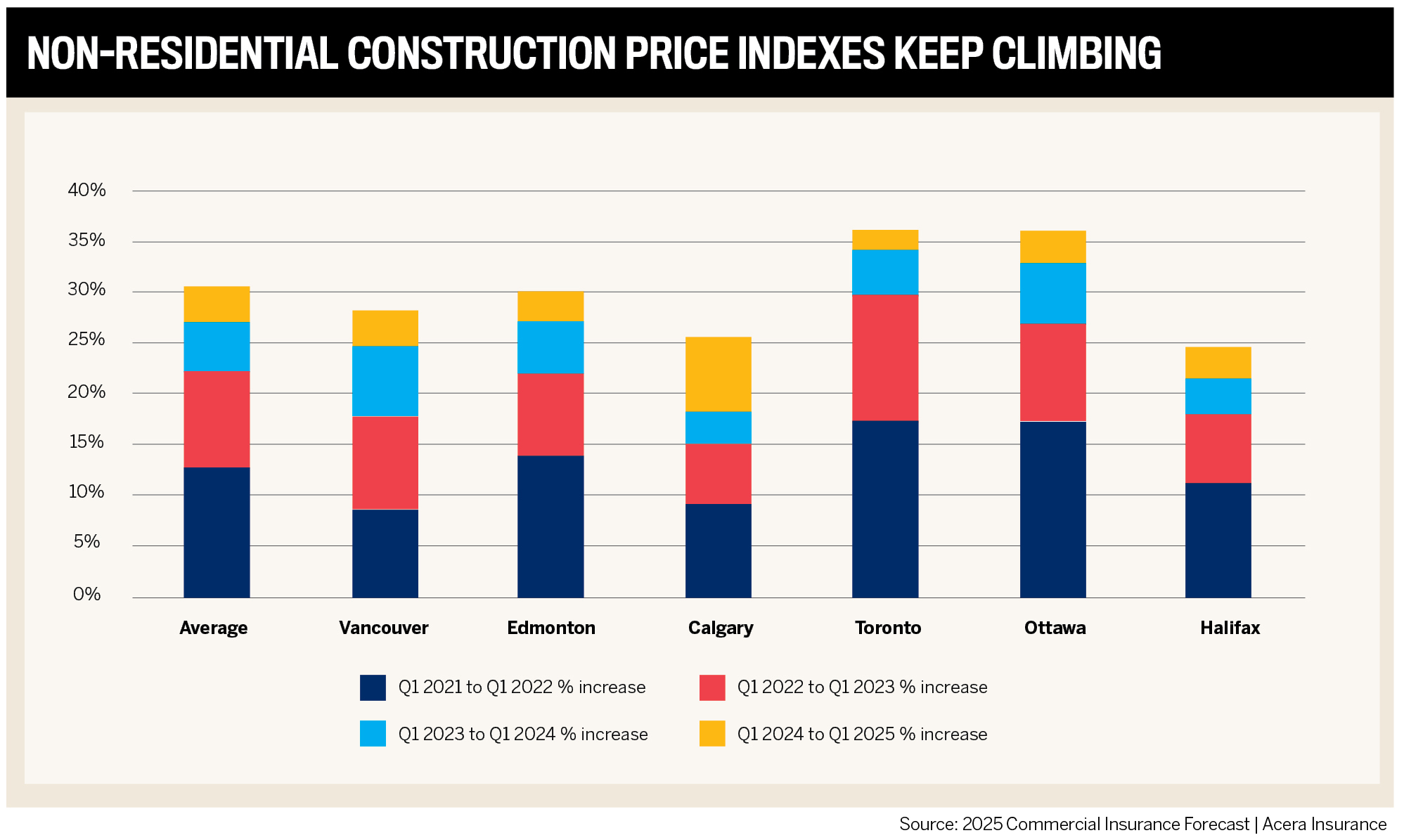
Costs are compounding that complexity. Construction materials, labour, and replacement parts have surged in price, putting pressure on rebuild timelines and insurance settlements, according to Acera Insurance’s 2025 Commercial Insurance Market Forecast.
Supply chain issues persist, and some insurers are now steering clients toward sustainable materials when settling claims. Non-residential construction price indexes across Canada continue to climb, highlighted in the chart below, and brokers say clients are more sensitive than ever to post-loss outcomes.
As ESG interest fades and construction demand remains resilient, brokers are adjusting quickly. The best insurance companies for construction are the ones they trust to deliver.
“Service remains the top priority for us,” says Michael Rocchetti, director of commercial insurance at St. Andrews Insurance Brokers. “We know which markets excel at making contact and moving claims forward, and which ones fall short.”
In Insurance Business Canada’s Brokers on Construction 2025 report, brokers across the country rated insurers’ performance over the past 12 months, evaluating them on coverage, claims handling, underwriting, and broker support. Based on weighted scores and editorial panel review, the highest-scoring firms earned 5-Star construction awards.
Brokers aren’t slowing down. Confidence has stayed high for three years, and most expect their volumes to keep growing in 2025. However, as risks evolve and client demands increase, so do expectations. Brokers want better coverage for complex projects, faster placements, and solutions that work for smaller trades, and they’re not shy about saying so.
What brokers want: technical strength and fast turnaround times
This year’s 5-Star construction insurance companies are rising to meet broker expectations. The highest-scoring firms earned broker praise for responsive claims handling, strong technical expertise, and a willingness to tailor coverage without losing sight of value.
As brokers placed greater weight on underwriting insight and service consistency, IBC’s winners delivered both. They combined practical support with reliable turnaround times, proving that strong relationships work best when paired with execution.
“Brokers are optimistic because there’s demand, but if insurers don’t match that with fast turnaround times and responsiveness, deals stall,” Rocchetti notes.
🔍 Key trends
📈 Rising priorities
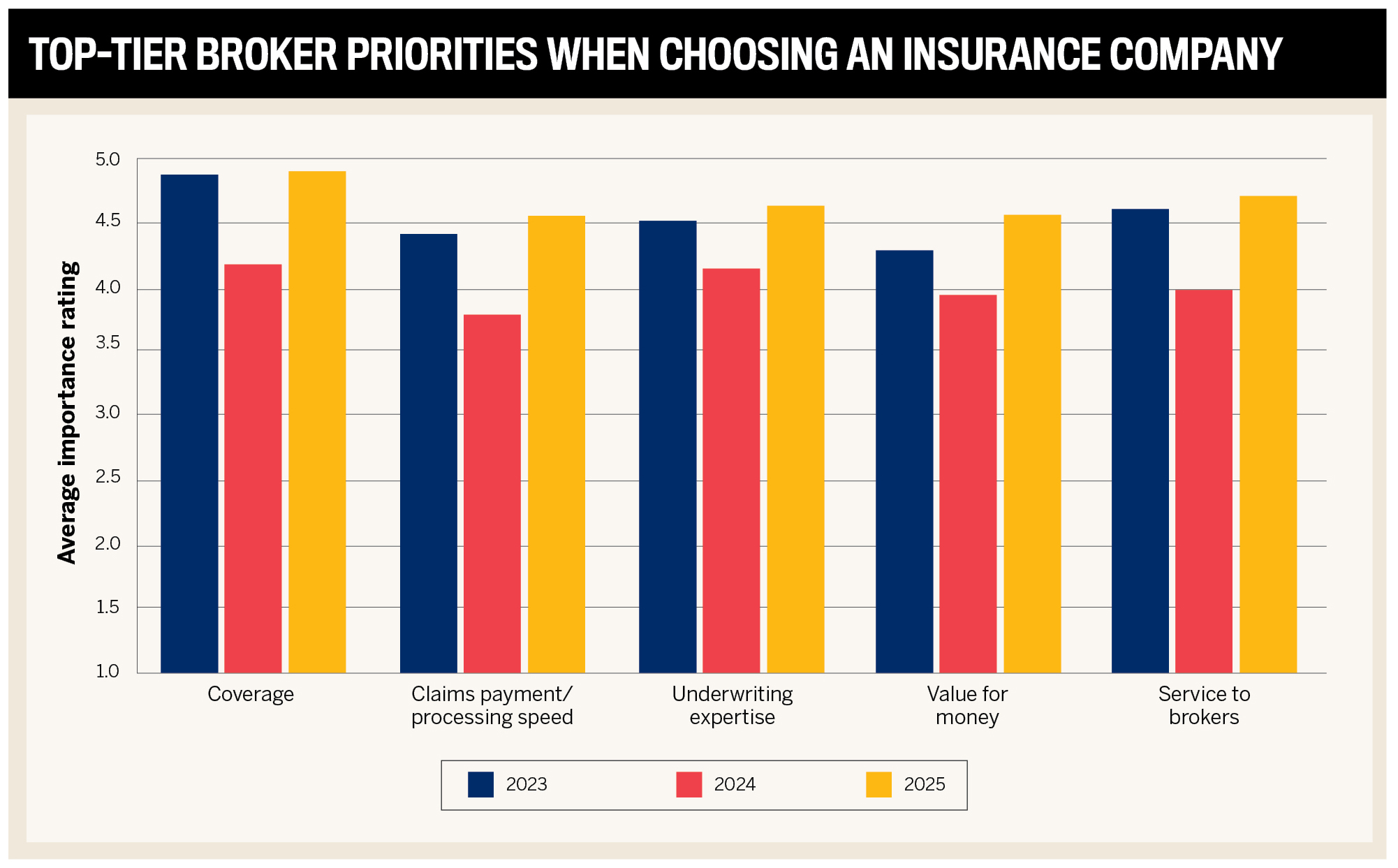
Coverage rebounded in 2025 after dipping in 2024, returning to its top spot at 4.91. This suggests that product breadth and relevance remain brokers’ primary concern.
Claims payment/processing speed jumped from 3.80 in 2024 to 4.57 in 2025, likely reflecting heightened expectations around turnaround times and efficiency.
Underwriting expertise continued to rise steadily
(4.16 → 4.65), showing that brokers are placing increasing value on technical knowledge and consistency in decision-making.
Value for money also rose in 2025 (3.96 → 4.57), indicating that pricing competitiveness is regaining focus, possibly due to market softening or client cost pressures.
Service to brokers climbed to its highest point in three years at 4.72, reinforcing that relationship management and support are top of mind.
🟰 Stable
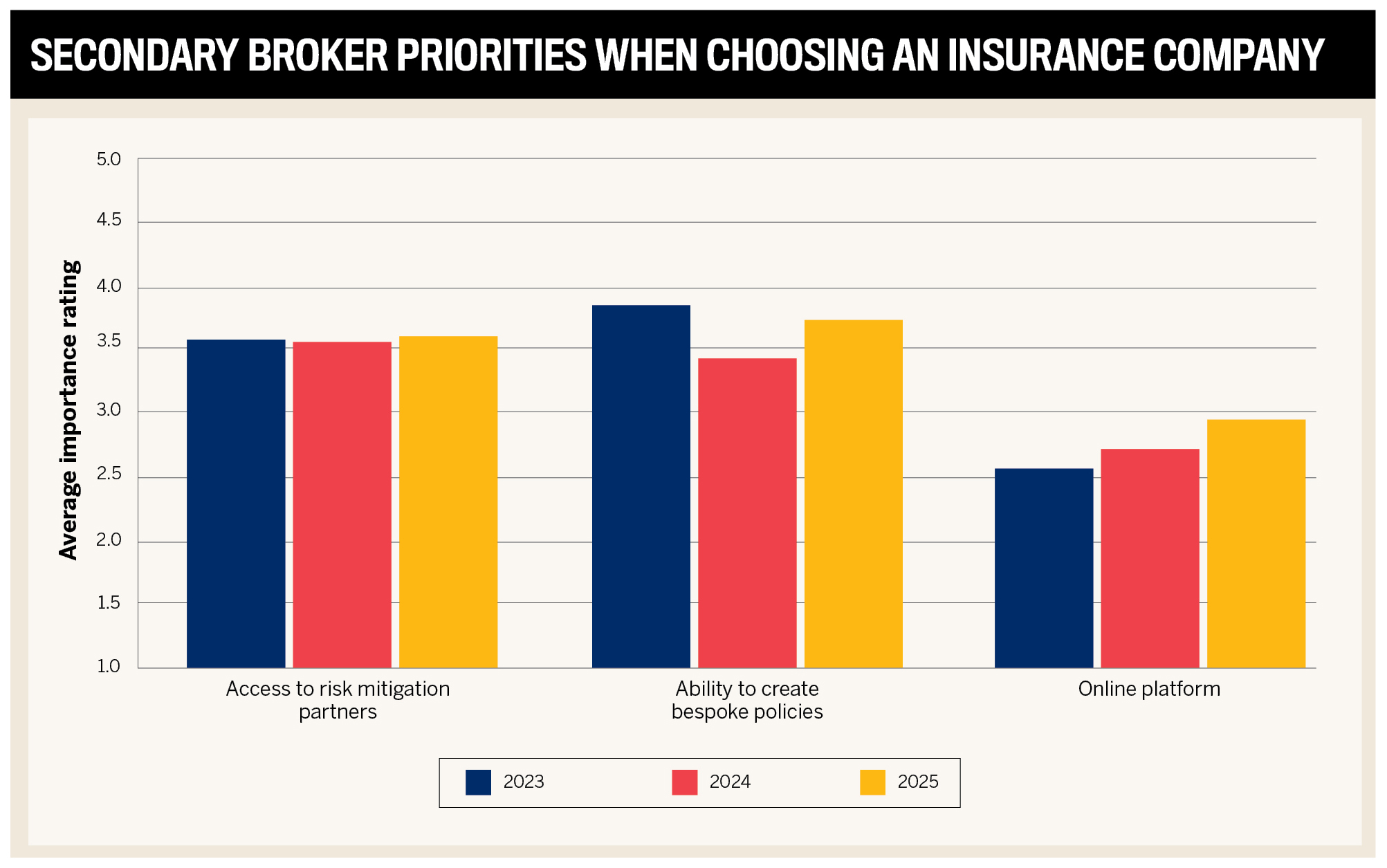
Access to risk mitigation partners remained relatively flat across the period (3.60 → 3.59 → 3.63). It remains essential but not top-tier.
The ability to create bespoke policies rebounded to 3.76 in 2025 after slipping the previous year, suggesting a renewed broker focus on tailored solutions. While not steep, the uptick points to an understated but gradually growing priority.
Online platforms are slowly but surely improving in perceived value (2.58 → 2.73 → 2.98) – though they still rank at the bottom. Brokers may appreciate digital tools, but core service still matters more.
📉 Notable shift
The 2024 dip across nearly all criteria may reflect a moment of market tension or transition. Whether driven by economic conditions, service disruptions, or broker frustration, the lower scores in that year contrast with the 2025 rebound.
Flexibility and innovation top brokers’ wish lists in 2025
IBC’s data shows that brokers are asking for better pricing. Many also want increased capacity, especially in wood-frame construction, and more domestic carriers’ participation in project-specific cover.
They’re also looking for tailored solutions, particularly for smaller contractors who need E&O coverage bundled affordably.
Rocchetti says, “Flexibility is incredibly important. Additional insured are asking for more comprehensive terms and conditions on certificates, some of which certain markets won’t accommodate. The ability to honour these evolving contractual requirements is a big differentiator.”
For HUB International vice president, account executive Karim Zein, not all risks are the same.
“Working with insurers who are able to adapt and customize their coverage to meet the client’s needs demonstrates their commitment to that risk,” he says.
While some brokers pointed to gaps in insurer responsiveness, others emphasized the value of building strong partnerships with underwriting teams.
“A strong relationship with underwriters, along with a well-written submission, goes a long way,” explains Zein. “These key points have led to more capacity, flexibility, and better service.”
“More creativity all around” summed up the sentiment of several respondents, who said current offerings aren’t keeping up with client needs. Transparency from MGAs, better digital tools, and recognition of tech-based risk mitigation were also common asks.
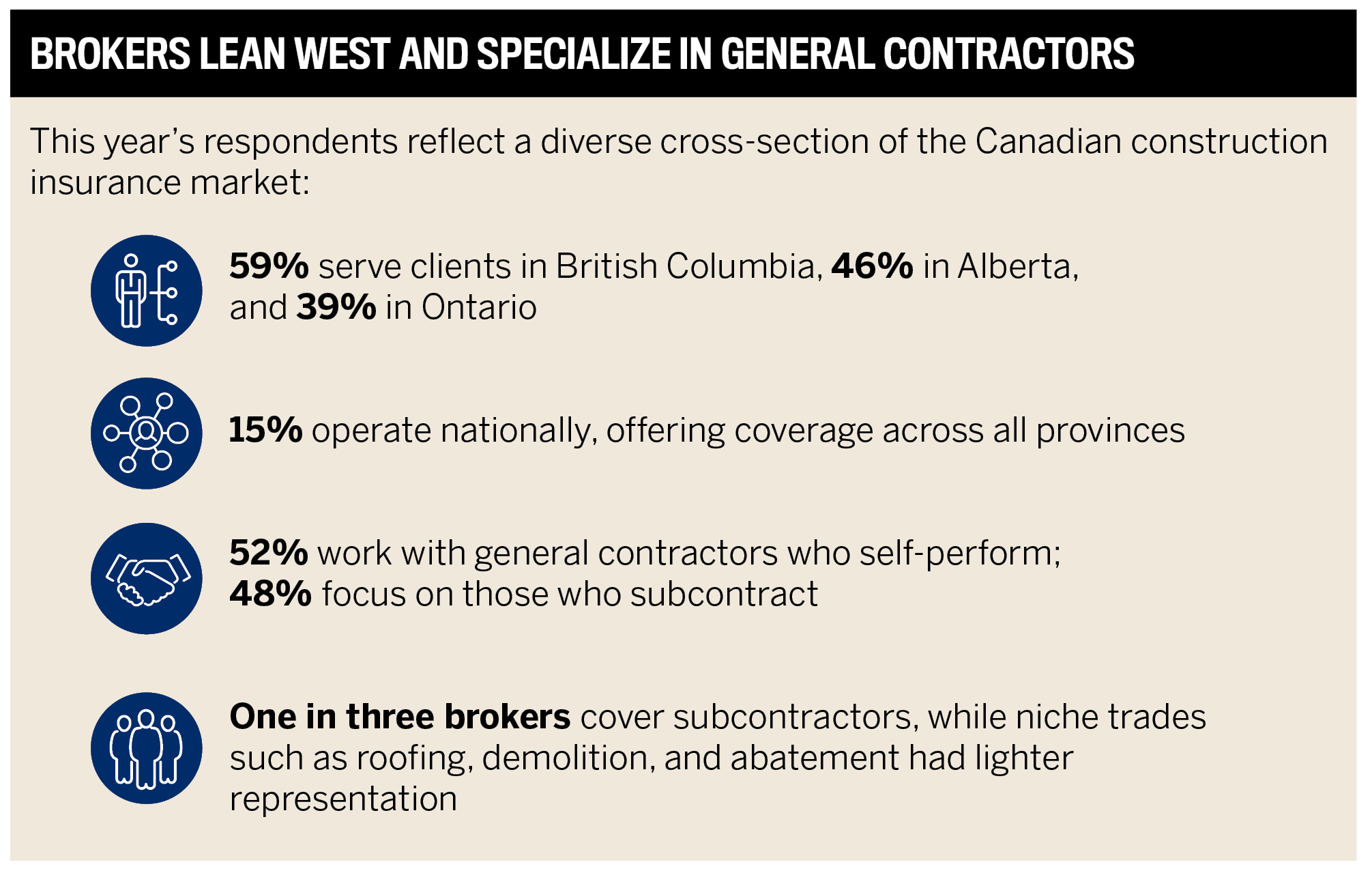
Top six takeaways
-
Capacity is the dominant concern
Multiple brokers flagged a lack of capacity as a persistent barrier, especially in wood-frame construction and amid rising project values. Comments such as “more capacity,” “capacity hasn’t increased,” and “more participation from domestic markets” point to the need for broader limits and greater involvement from Canadian carriers, not just MGAs or the Lloyd’s market.
-
Appetite for specialization and tailored solutions
There’s a call for more flexible products, especially for smaller contractors and unprotected locations. Brokers mentioned “more ability to do tailored solutions.” They raised the need for affordable bundled options for low-risk but contractually required coverages, including embedded E&O. These comments point to gaps in how current offerings match today’s construction needs.
-
Pricing pressure remains
Comments such as “better rates,” “more discounts,” and “less subjectivities” show that brokers are feeling pricing tension. While it’s not the only concern, rate sensitivity remains on everyone’s radar, especially as job values and bonding requirements rise.
-
Technology and innovation as differentiators
Some brokers want carriers to reward clients for using advanced technologies to reduce risk, such as IoT sensors for water leaks. There’s an appetite for “more entrepreneurial underwriters and coverage innovation,” as well as innovation in tools and how risk is rated.
-
Service expectations and transparency
Brokers want faster confirmation of binding and smoother online workflows. One respondent pointed to “increased requirements from carriers regarding confirmation of coverage upon binding,” while another asked for “more online platform for brokers, from quote to bind and service.” The call for “more transparency from and increased regulation of MGAs” reflects growing frustration with unclear or inconsistent servicing, especially on complex or time-sensitive placements.
-
Broker support and education
One broker called for “more education for brokers,” while others noted confusion around niche coverages such as E&O for smaller contractors and environmental liability. These are the kind of gaps brokers believe, if addressed, could improve placement confidence and strengthen their insurer relationships.
From builder’s risk to cyber: how broker focus has evolved
Brokers placing construction insurance are weighing a shifting set of priorities. While builder’s risk and general liability remain essential, IBC’s survey reveals a rise in demand for auto, cyber, and workers’ compensation lines.
Over the past three years, brokers have paid increasing attention to risk areas once considered secondary, pointing to broader changes in project dynamics, client expectations, and loss activity.
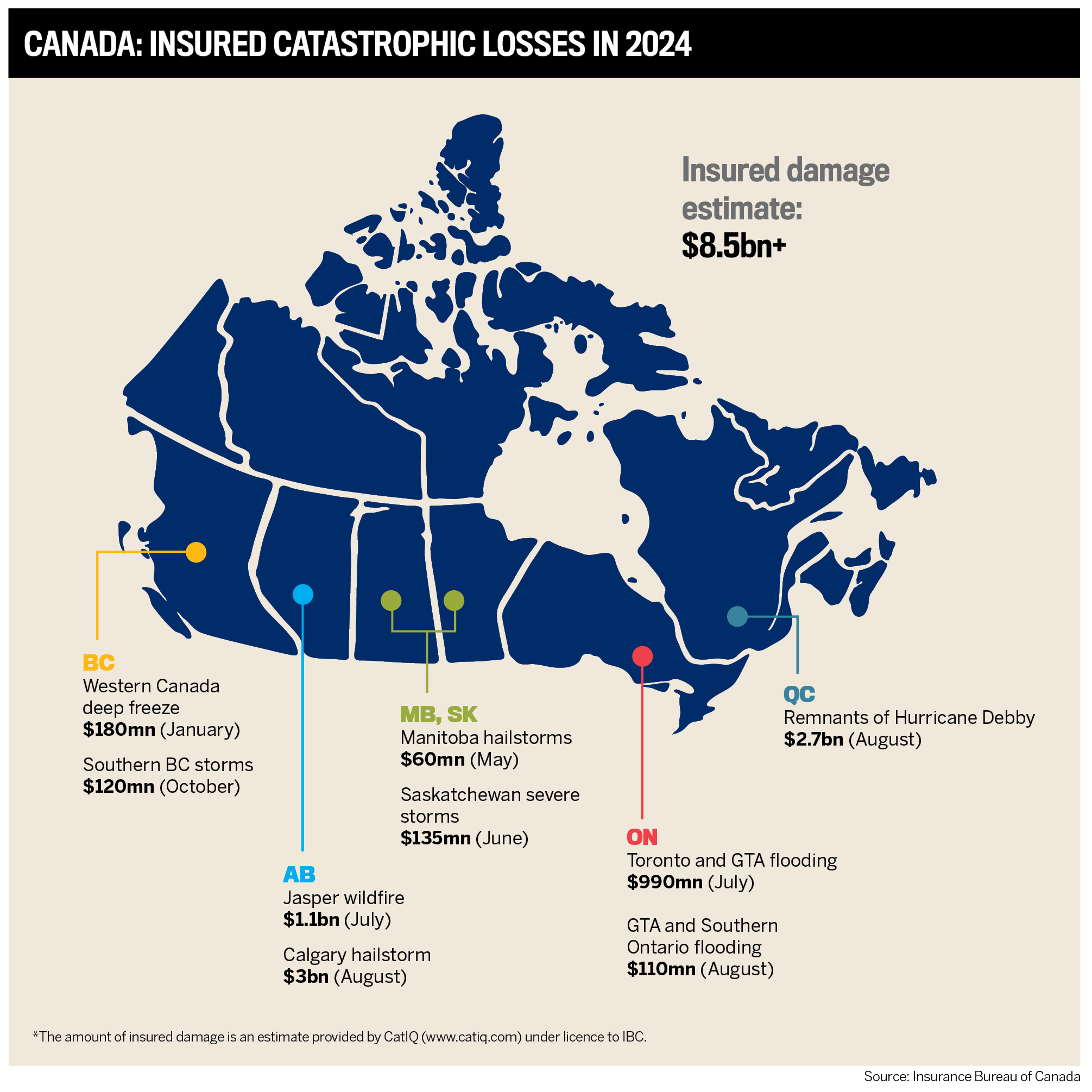
That shift isn’t theoretical. In 2024, Canada recorded over $8.5 billion in insured losses from severe weather, the highest total in the country’s history. According to Catastrophe Indices and Quantification (CatlQ), four catastrophic events in July and August alone triggered over $7 billion in claims, half the volume insurers typically see in an entire year.
For general liability, Rocchetti explains that it’s critical that all operations are fully included and accurately reflected in the policy.
“Overlooking operational exposures is one of the most common and costly errors in this segment.”
Here’s how those priorities have evolved from 2023 to 2025.
🔍 Key trends
Core lines
📈 What’s rising
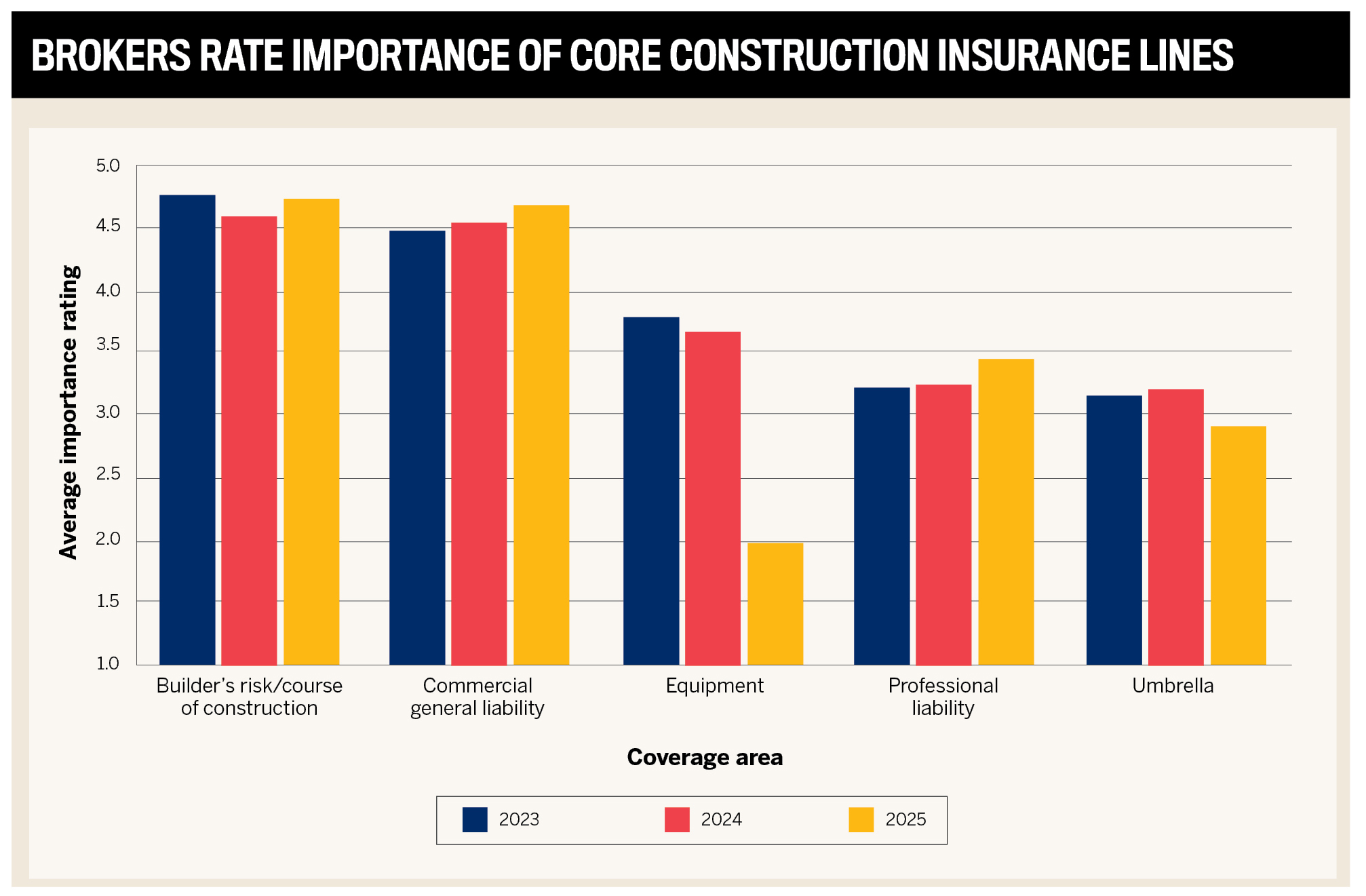
Professional liability has shown steady, modest growth (3.25 → 3.26 → 3.48). Brokers may be emphasizing design and engineering risk more, particularly complex builds or integrated project delivery models.
📉 What’s falling
Equipment dropped sharply in 2025, falling from 3.70 to 2.00. This is the largest drop among the core coverages and may point to shifting client priorities or changes in how coverage is structured.
Umbrella has declined slightly across all three years
(3.18 → 3.23 → 2.93). This could reflect changing thresholds in primary limits or cost-driven adjustments.
🟰 What’s stable
Builder’s risk and commercial general liability remain the foundation of most construction insurance placements. Both dipped slightly in 2024 but rebounded in 2025 to their highest scores yet (4.76 and 4.70), reinforcing their central role in how brokers choose insurance partners.
Emerging lines
📈 What’s rising
Auto liability saw a dramatic spike from 2.62 in 2024 to 4.17 in 2025, the biggest year-over-year change in the dataset. This may reflect increased exposure on large project fleets, tighter contractual requirements, or growing claims costs.
Cyber continues its upward trend (2.64 → 3.13 → 3.30), indicating that brokers are increasingly recognizing digital exposures on job sites, particularly with connected equipment and third-party systems.
Workers’ compensation jumped from the lowest-ranked line in 2023 (1.79) to a mid-tier position in 2025 (3.30). This may signal rising concern around job site safety, injury claims, or evolving provincial mandates.
🟰 What’s stable
Environmental liability has remained a consistent priority (3.01 → 3.47 → 3.39). While it doesn’t top the rankings, brokers view it as a key issue, especially on larger or more complex builds.
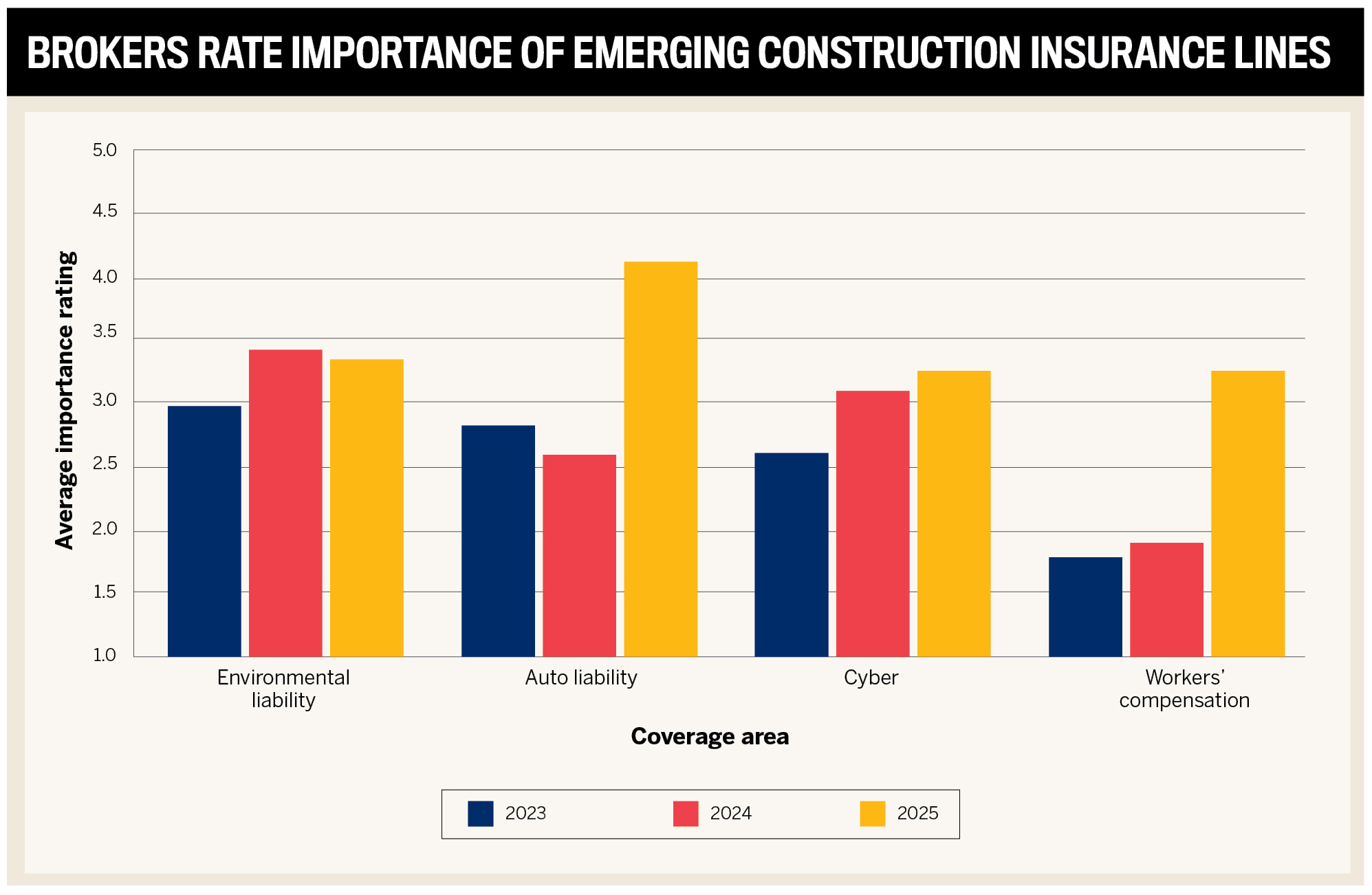
These shifting priorities reflect changing market conditions and point to clients asking brokers to step in with more insight and specialized support. The rise in auto, cyber, and workers’ compensation suggests a broader understanding of construction site risk and a need for more comprehensive conversations around coverage.
This year’s 5-Star construction winners are already meeting that challenge by delivering responsive underwriting, flexible products, and consistent broker backing.
“Risk mitigation tools are very important, but it’s the broker who ends up being the client’s first stop,” commercial insurance director Rocchetti explains. “When insurers equip brokers with accessible and client-friendly tools, it strengthens the entire relationship.”
Zein reinforces this view: “This is such a crucial tool for all parties involved. As construction evolves, so does risk. Educating brokers and clients through risk mitigation resources shows that insurers understand and specialize in their segment.”
As client expectations grow, these top performers are helping brokers stay ahead, protect their relationships, and confidently place coverage.
Why brokers rate Buildersure by Cansure a
5-Star performer
Brokers rated the company’s construction group highest for coverage and underwriting experience, two pillars that consistently top the list of broker priorities. Here’s how the team delivers on those expectations and why brokers are taking notice.
The leading MGA with carrier-backed capacity attributes its top broker ratings to:
-
delivering consistent coverage and experience that builds trust
-
a 32-person team and over 150 years of combined underwriting experience
-
long-standing market relationships enabling agility and underwriting innovation
“Entrepreneurialism is one of our core values, and we purposefully seek out underwriters who show this value intrinsically and continue to nurture it through purposeful career development,” explains Chris Pauli, executive vice president of construction. “This high-performance culture and accountability level empowers our team to strive for excellence.”


Chris PauliBuildersure by Cansure
Staying responsive in a faster market
Brokers want speed, and Buildersure by Cansure recently revamped its operations by implementing a new enterprise platform designed to improve service speed and streamline the submission review process, with full tracking from initial submission to binding.
“This proprietary platform allows us to see trends in our big data, especially when overlaid with our in-house claims analytics, to ensure we are approaching each account from a risk management perspective commensurate with current market conditions,” Pauli adds.
Serving brokers on their terms
With construction as its largest industry vertical, the award-winning team’s focus on flexibility shows how it serves brokers. From on-demand policy issuance through its portal to direct underwriting support on complex risks, the team strives to meet brokers where they work with tools that deliver speed and service.
“Our construction team brings together deep expertise that embraces innovation in our underwriting practice,” notes Pauli. “We are not only focused on delivering a best-in-class product, but we also want to serve brokers the way they prefer.”
Why Northbridge Insurance earns broker confidence and 5-Star award
Brokers gave the recurring winner top marks for coverage, underwriting experience, and service. That kind of performance stands out in a competitive market where broker demands are increasing year after year.
Northbridge excels in those areas by staying closely connected to the construction industry’s evolving needs.
The team maintains this edge by:
-
investing in continuous training
-
leveraging technology partnerships
-
building strong relationships with customers and brokers
As brokers face tighter timelines and higher client demands, Northbridge has delivered fast turnaround, technical strength, and consistent support.
“We navigate the ups and downs of the P&C industry by creating innovative solutions and sticking to our value proposition as a commercially focused carrier,” explains Jonathan Graham, underwriting director of construction and contracting. “We prioritize quick turnaround times without compromising the quality of our technical assessments, and we share that knowledge with our clients and brokers.”

Jonathan GrahamNorthbridge Insurance
A key component of its success is its internal future-focused training.
“We’re continuously sharpening our skill set to make our brand synonymous with industry-leading service and expertise and a solution-oriented mindset,” he adds.
Solutions that go beyond the policy
As a leader in the construction space, Northbridge pushes beyond expectations by being in lockstep with customers’ needs. It ensures every construction team member conducts site visits to gain first-hand insight into the challenges clients face daily.
Northbridge’s underwriting and risk services teams work quickly and efficiently to deliver tailored solutions for brokers and customers alike. The focus is on ease of business and addressing complex requirements, offering value beyond premiums and claims.
That commitment shows up in practical ways, from helping contractors navigate firebreak regulations to secure permits to offering specialized driver hiring and training support in remote communities.
“We prioritize listening to our insureds and broker partners, equipping them for a safer, brighter future,” Graham says. “Our consistent approach emphasizes safety and customizes solutions to meet each customer’s unique needs.”
Broker confidence holds steady as construction demand stays strong
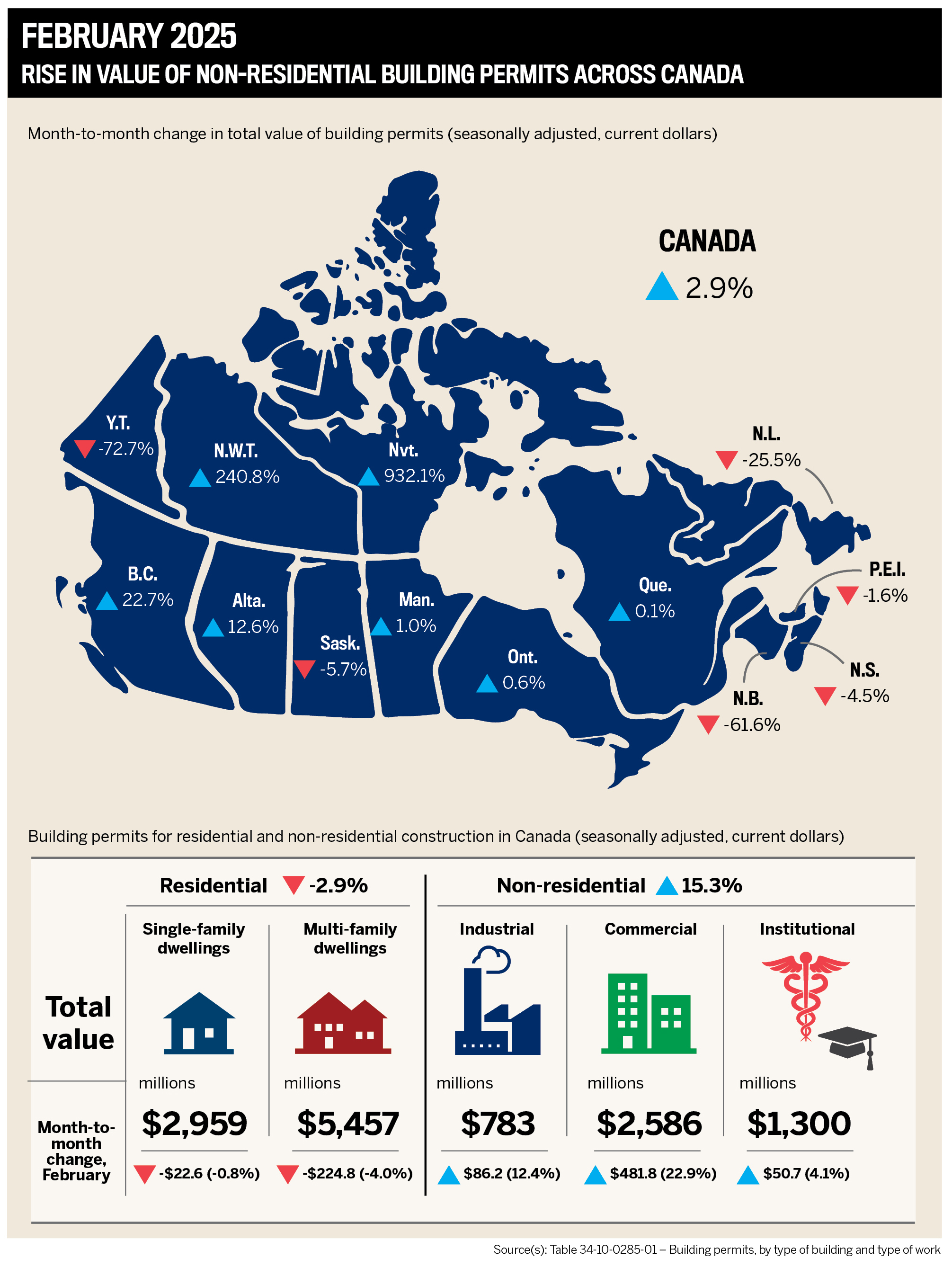
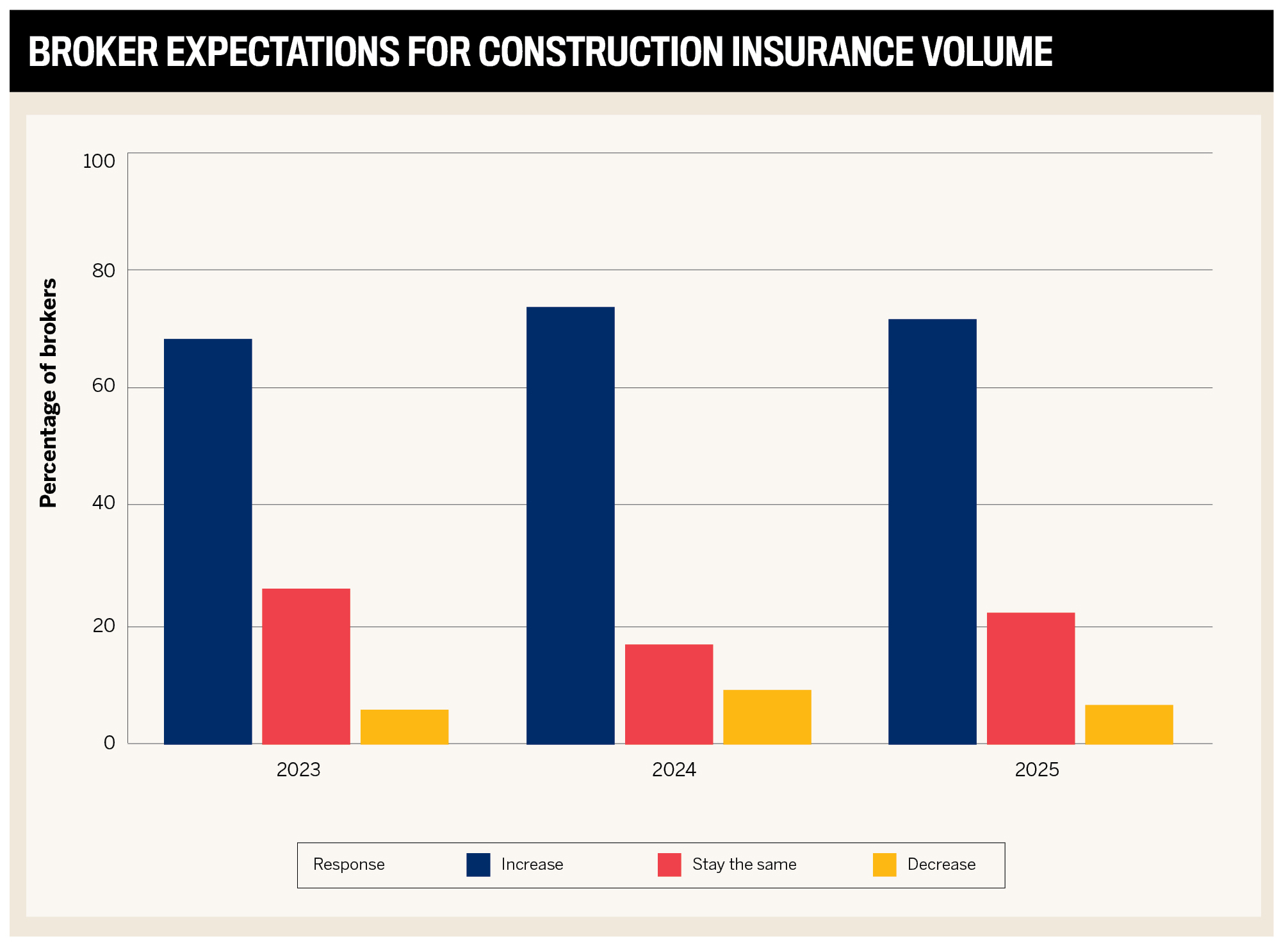
Most brokers continue to expect growth in construction insurance. In 2025, 72% predicted an increase in volume, while 22% said it would stay the same. Only 7% expected a decline. Optimism peaked in 2024, but expectations remain high overall, reflecting a reliable pipeline of project work and sustained client demand.
Statistics Canada reported a 2.9% increase in the total value of building permits in February 2025, reaching $13.1 billion. On a constant dollar basis, permit values were up 5.6% year over year, a sign of steady construction activity, particularly non-residential builds across provinces such as British Columbia.
This year’s IBC 5-Star construction insurers are well positioned to meet that demand. Brokers pointed to efficient claims handling, dependable underwriting, and attentive service as the traits that set these firms apart. These qualities will only grow more critical as volumes rise and risks become more complex.
“We’re in a very soft and highly competitive market,” Rocchetti reflects. “Insurers that remain flexible, responsive, and open to tailoring solutions will be in the best position to thrive.”
Zein adds, “Insurers should be investing heavily in technology to further advance their capabilities to remain competitive, along with offering great service to brokers. Quick turnaround times and communication generally lead to more success.”
The overall three-year trend shows brokers remain consistently bullish, with slight softening.
🔍 Key takeaways
-
Strong, stable confidence: Each year, more than two-thirds of brokers expected growth – 68.1% (2023), 74% (2024), and 72% (2025) – indicating consistent optimism.
-
2024 peak optimism: Broker confidence reached its highest point in 2024, with nearly three-quarters expecting growth, a high-water mark in the data.
-
2025 reset: A modest dip in growth expectations (from 74% to 72%) alongside a rise in neutral responses (17% to 22%) points to a more measured outlook this year.
-
Minimal concern about decline: Fewer than 10% of brokers expected a decrease in any year, suggesting limited concern about contraction across the board.
ESG drops off the radar for many brokers this year
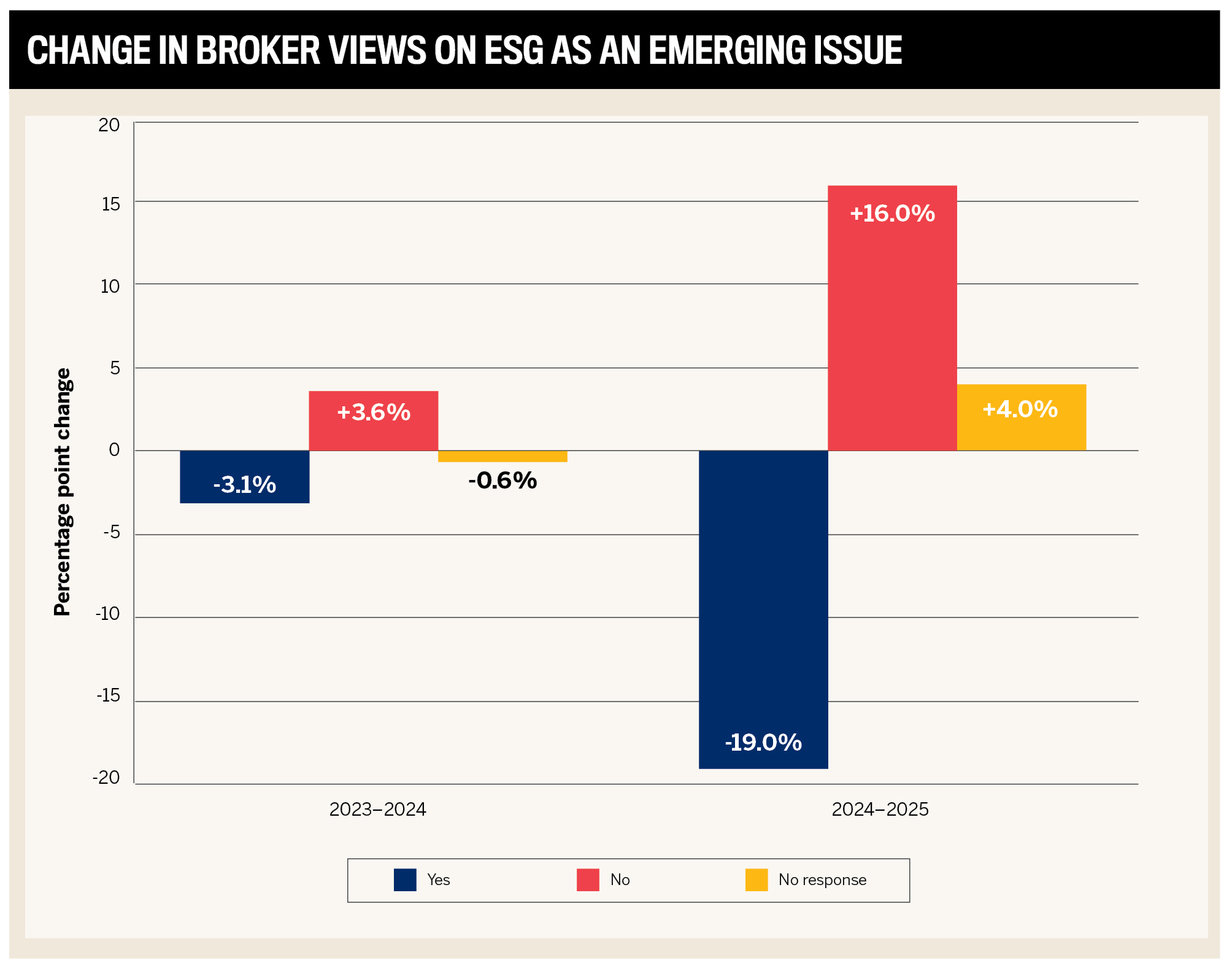
Broker sentiment on ESG has shifted noticeably over the past year. In 2023 and 2024, a majority agreed it was an emerging issue in construction coverage. But in 2025, opinion split down the middle – 46% said yes, while 46% said no.
The number of brokers who skipped the question also nearly doubled, suggesting ESG may no longer be a consistent concern across the industry or that more immediate client priorities are overshadowing it.
🔍 Key takeaways
-
Split opinion in 2025: For the first time, brokers were evenly divided on ESG’s relevance to construction insurance.
-
Support is falling: Affirmative responses dropped from 65% in 2024 to 46% in 2025.
-
Uncertainty is growing: More brokers left the question unanswered, rising from 5% to 9%.
-
Context may be shifting: ESG is no longer viewed as a clear-cut emerging issue, suggesting brokers are either deprioritizing it or waiting for more direct links to underwriting.
Conclusion: brokers want more, and the best are delivering
In 2025, brokers must place complex risks faster, find coverage that fits, and support smaller trades without delay. They’re asking more of insurers, and they’re not pulling punches.
IBC’s 5-Star construction insurance companies of 2025 earned recognition by cutting through placement bottlenecks, staying flexible on coverage, and keeping service consistent.
Rocchetti reinforces that speed of claims handling is a core decision factor at his brokerage, St. Andrews Insurance Brokers in Ontario.
HUB International’s Zein agrees: “Construction is a very fast-paced, tight-deadline industry. Speedy claims service ensures that the client can move on to the next project without potentially disturbing their finances. This is a driving factor in a lot of our recommendations to clients.”
Service, claims, and value scores all improved, indicating a demand for execution across the board. Meanwhile, brokers highlighted a need for clearer MGA relationships, more education on niche risks, and recognition of technology that lowers exposure.
“Simplicity is key,” adds Rocchetti. “We value platforms that are intuitive, ask clear and relevant questions, and allow brokers to get things done without unnecessary delays or complexities.”
User-friendly is the key for Zein. “It has to be easy to navigate and able to bind or issue policies immediately without being referred to an underwriter. If it has to go to underwriting, quick turnaround is always best.”
What sets top performers apart:
-
strong technical underwriting with market-aware responsiveness
-
capacity and creativity where brokers face friction
-
operational models that shorten timelines without compromising quality
-
a service mindset that meets brokers where they are digitally, tactically, and relationally
Construction demand is holding. Broker expectations are not. The insurers that listen, act, and adapt fast will be the ones Canada’s brokers turn to first.
The Best Insurance Companies for Construction in Canada | 5-Star Construction


- AIG
- Aviva
- Berkshire
- Burns & Wilcox
- Economical
- Forward
- Intact
- Premier Canada Assurance Managers
- Sovereign General
- SRIM
- Starr
- Trisura
- Zurich
Insights
-
 Karim Zein
Vice President, Account Executive
HUB International -
 Michael Rocchetti
Director, Commercial Insurance St. Andrews Insurance Broker
Methodology
To select the best construction insurers for 2025, Insurance Business Canada sourced feedback from insurance brokers. IBC’s research team began by conducting a survey across a wide range of brokerages to determine what brokers value in a construction insurer. The team also spoke to hundreds of brokers across the country, asking them to rate the construction insurers they had worked with over the past 12 months.
The in-depth information gathered enabled the research team to assign weighted values to each of the criteria being rated by the brokers. The quantitative results were combined with the editorial panel feedback. At the end of the research period, the insurers that offered the best overall service to brokers were named 5-Star award winners.
Keep up with the latest news and events
Join our mailing list, it’s free!