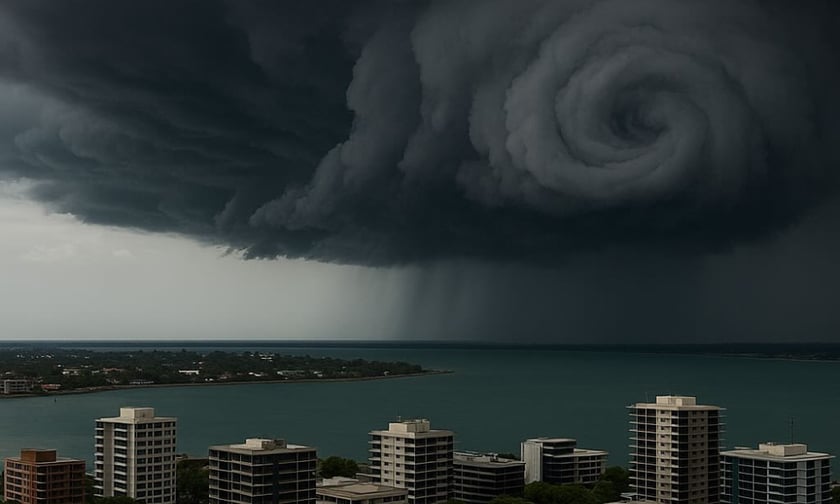
Darwin and parts of the Top End are preparing for potential impact from Tropical Cyclone Fina, with emergency authorities and insurers closely tracking a system that has intensified earlier in the season than is typical for northern Australia.
The Bureau of Meteorology has just issued a cyclone warning covering the Darwin region, the Tiwi Islands and western Arnhem Land as Fina moved toward the Northern Territory coast. The bureau said the cyclone, initially categorised as a category one system, has strengthened to category two and could reach category three later on Friday or early Saturday.
The approach of the storm has already caused widespread disruption. Schools have closed in Minjilang, Warruwi, Milikapiti and Pirlangimpi, ferry operations between Darwin, the Tiwi Islands and Mandorah have been suspended, and Charles Darwin University has shut its Darwin campuses. AFL NT cancelled weekend fixtures, although schools in Darwin itself remain open at this stage.
The bureau reported that Fina was “moving east about 370km north-east of Darwin” before an anticipated southerly turn, and that the system could reach the NT coast for “potential impact” on Friday or Saturday. Senior meteorologist Jonathan How noted that Australia’s earliest recorded landfalling cyclone was Ines, which crossed the Kimberley on 21 November 1973. The earliest to cross the NT coast was Alessia on 27 November 2013. He said that “based on Fina’s track map it could also cross the coast on the 21st, 22nd November, so that could equal the record for earliest landfall,” adding that such timing would be the earliest for the Territory.
Australia’s cyclone season officially begins on 1 November, but historically the first coastal crossing usually occurs in mid-December or later. The latest track maps indicate the Greater Darwin area could be affected by severe winds and heavy rainfall.
The last notable cyclone to impact the city was Marcus in 2018, which reached category two intensity as it crossed the coast with wind gusts of 130km/h, toppling trees and damaging power infrastructure. Marcus caused comparatively moderate insured losses, but its footprint reinforced concerns about the vulnerability of older housing stock across the region.
Fina arrives at a time when the long-term behaviour of tropical cyclones is under close examination. Prof Steve Turton of Central Queensland University told The Guardian that global trends point to storms becoming more intense. “We do know that with climate change that we’re expecting the intensity of these storms to increase. We’re expecting them to intensify more rapidly. We’re already seeing those patterns,” he said. He noted that sea surface temperatures in the Timor Sea were above average, exceeding the 26.5°C threshold required for cyclogenesis. Fina’s relatively compact structure also means it could “spin up quicker” but weaken rapidly, depending on its environment.
For the insurance industry, Darwin’s exposure carries a unique historical weight. The region is still shaped by the legacy of Cyclone Tracy, which made landfall on 25 December 1974 and caused damage on a scale unmatched in modern Australian catastrophe history. Tracy resulted in 66 fatalities and wind gusts of at least 217km/h before instruments failed. More than 70 per cent of the city’s buildings were damaged or destroyed, leaving roughly 41,000 residents homeless. Losses exceeded A$800 million in 1974 dollars, commonly referenced as equivalent to about A$7.7 billion in today’s terms once inflation and economic growth are accounted for.
Tracy became the catalyst for sweeping reforms to building standards in cyclone-exposed regions, establishing frameworks that continue to inform underwriting and catastrophe modelling. The event demonstrated how a relatively small but highly concentrated cyclone can produce disproportionately severe destruction — a lesson that remains central to understanding Top End vulnerability.
With Fina tracking unusually early and over warm waters, insurers will be watching how the system evolves as it nears land. Although its ultimate intensity remains uncertain, the combination of rapid-intensification potential, regional infrastructure sensitivity and continuing climate influences underscores the importance of close monitoring and preparedness as the Territory heads into a volatile season.