
Best Insurance Companies to Work for in Canada | Top Insurance Employers
Jump to winners | Jump to methodology
More than a paycheck
“Employees are looking for companies that truly care about them, offer job stability, and provide competitive salaries and benefits,” says Stefan Rolfe, director of Impact Recruitment. “It’s about creating an environment where people feel valued and supported with a solid reputation for looking after their people.”
This need to comprehensively cater to employees’ needs is the hallmark of Insurance Business Canada’s Top Insurance Employers 2025 – organizations that earned a place on the prestigious winners’ list after their employees completed an anonymous survey evaluating their workplace and submitted it to IBC. The winning group is a collection of organizations that have created packages to ensure their employees are well catered for.
Cal Jungwirth, director of permanent placement services at Robert Half, explains, “Competitive salary remains foundational, but what truly sets leading organizations apart are the perks, benefits, and culture that go beyond. Organizations that foster a trusting work environment and a flexible culture and commit to their employees’ development can maintain an edge.”
The Top Insurance Employers 2025 are winning in the “war for talent,” according to Krisztina Veres, president of Veres Career Consulting. She pinpoints how employees will leave unless they are valued.
“Retaining existing team members is more challenging than ever. It is interesting to note that job stability matters more to tenured employees; those who have recently changed jobs will likely consider doing so again, unless they receive a better offer from their current company.”
And she adds, “Appreciation, caring, and listening are keys. Employers should offer a work-life balance and demonstrate to employees that they care about them.”
IBC data analysis
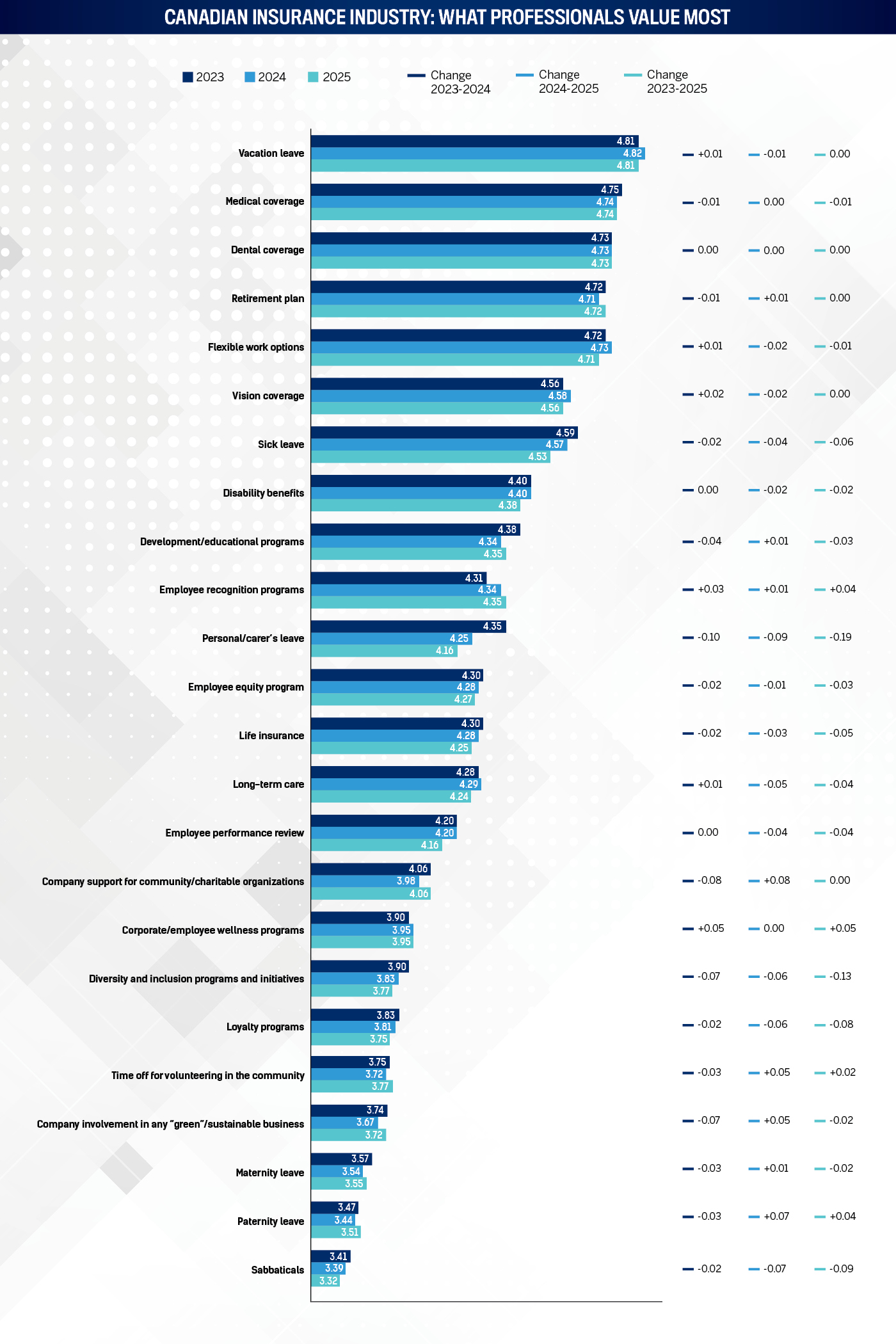
Over the last three years, respondents, who work in the Canadian insurance industry, answered the following question: “Please rate the following where 1 = not important and 5 = very important to you irrespective of whether your company offers any of the following.”
Decreased importance
-
Sick leave and personal/carer’s leave: The slight decline may reflect a stabilization in pandemic-related concerns. In 2024, the Canadian insurance sector saw a normalization of hybrid and in-office work, with fewer COVID-19 disruptions. Employees may now perceive sick leave as a standard benefit rather than a differentiator, especially as most insurers already offer robust leave policies.
-
Diversity and inclusion programs and initiatives: Likely due to a sense that many insurers have already implemented baseline diversity, equity, and inclusion (DE&I) initiatives, making them less of a competitive differentiator. In 2024, industry reports noted a shift in focus from launching new DE&I programs to measuring and reporting on existing ones, which may have reduced their perceived novelty or urgency among employees.
-
Loyalty programs and sabbaticals: These remain less critical, possibly because employees are prioritizing immediate, tangible benefits over long-term or infrequent perks. Economic uncertainty has led Canadian insurers to focus on core benefits, and employees may have adjusted expectations accordingly.
Increased importance
-
Paternity leave: Aligns with a broader industry and societal push for gender equity and family-friendly policies. The leading Canadian insurers enhanced their parental leave offerings, responding to employee demand for more inclusive family benefits.
-
Company support for community/charitable organization, time off for volunteering in the community, and company involvement in any “green”/sustainable business: These increases reflect a growing emphasis on corporate social responsibility (CSR) and environmental, social, and governance values. In 2024 and 2025, Canadian insurance companies increased their public commitments to sustainability and community engagement, which resonated with employees seeking purpose-driven work environments.
Best insurance companies to work for in Canada 2025

Employees: 1,000+
Year founded: 1987
HQ: Montreal
BFL CANADA, one of the nation’s largest brokerages, emphasizes a strong, values-driven culture rooted in respect, belonging, and pride in being a privately owned Canadian organization. Its mission is to make employees feel part of a family rather than just a workforce.
That really hit home for Tan Singh, chief human resources officer, when reading one comment in last year’s annual engagement survey. “Someone actually wrote, ‘BFL is the place to come to heal the trauma that you’ve had from other companies.’ I think that summarizes it; people come here, and they realize they’re not a number or a drop in the bucket.”
This spirit stems from the firm taking pride in its reputation and doing all it can for its employees. “The value proposition is when you’re sitting around a dining room table, you’re proud to speak about BFL CANADA; you would never feel embarrassed or ashamed by the decisions we make,” explains Singh. “You wouldn’t ever hear about BFL cutting corners or making decisions that aren't right for our people.”
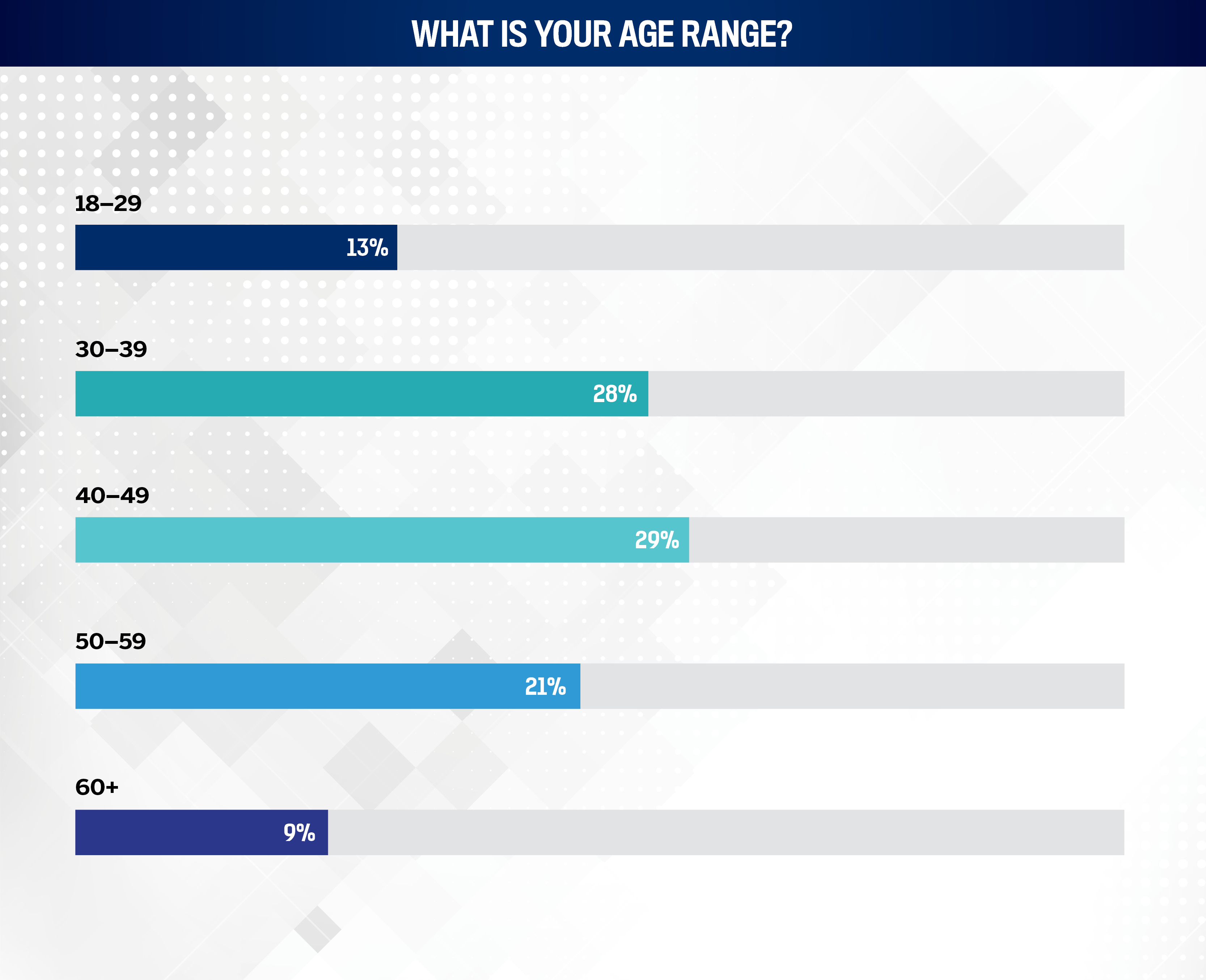
The core values stem from a strong influence from founder Barry Lorenzetti and president Lisa Giannoni, who have instilled the family feel. Part of this relates to the degree of inclusion. For example, 10 percent of employees are over 60, with some even above 80.
Singh says, “We keep people with us as long as they want to stay, and it’s because they are really passionate about insurance. They mentor, and there’s a lot of knowledge they have. We are very respectful to people that have helped build the organization.”


“Everybody’s voice matters; we want them to feel that they have a place where they belong and are respected. Our most important asset is our employees, and we live by that. We never forget it”
Tan SinghBFL CANADA
As in any family, everyone has a say. BFL encourages its team to take advantage of being part of a relatively small firm, compared to much larger competitors. This is reflected in an 80 percent engagement rating.
“There’s no idea that would be dismissed. It’s a great place because we don’t have the bureaucracy and the red tape, and you don’t have to go through so many levels,” says Singh. “I feel very empowered as an HR person to implement programs, practices, and policies that can enhance the culture and make it an even better place to work.”
BFL is now also seeing the results of investing in their benefit program, particularly around mental health and wellness, with a subsidy of up to $300 per year. There are mental health monthly sessions that staff can all take part in, along with blood glucose sessions and also advice around nutrition. The next step is a stress management program with Concordia University.
“We’re a sales organization, and the pressure is high, so we’ve hired them to do sessions in all of our offices on how to manage stress, not just in the workplace but also at home as well,” says Singh.
Being privately owned is another key aspect of how BFL maintains a family atmosphere. Singh details the President’s Share Bonus, awarded to someone who has performed excellently, regardless of what area of the business they are in.
“It’s not a loan; they don’t have to pay that back. They’re granted shares, and that can be upwards of $50,000 to $100,000 that’s gifted to the employee,” she explains.
With 27 offices across Canada, ensuring everyone feels together is a priority, along with the more regional offices understanding they are equally as important as the big city locations. This is achieved by the simple principle of communication.
“We want to make sure people’s experience is positive. When we see offices that become a little bit disconnected or distant from us, we swoop in and make sure that they feel connected to our culture,” adds Singh. “The executive team travels across Canada twice a year, where we present in town hall settings, and then we have Q&As, and people can ask anything.”

Employees: 1,000+
Year founded: 1890
HQ: Toronto
Northbridge Financial Corporation donates two percent of pre-tax profit to charities, all related to children and youth, and this corporate social responsibility strikes a chord with their team. The aid is given to groups including SickKids, Jack.org, Thrive Youth Development Canada, and Pathways to Education.
“When we do well, we do good for our communities,” says senior vice president of people and culture, Harold Weckworth. “Our focus around children is about giving them the opportunities, whether that be around things like education or food security. We’ve done that for quite some time, and it really resonates with our employees.”

“We hone in on our people-first culture. It resonates with employees, and they see that we generally care about making a difference. It’s really important for our employees to see that”
Harold WeckworthNorthbridge Financial Corporation
Another initiative that employees have reacted to is that of Northbridge University. It was launched in 2025 to give everyone more visibility across the company by taking advantage of learning opportunities.
It enables the team to learn outside of their own areas and more about the overall business and develop into more polished employees, as well as keeping them engaged with emerging topics such as AI.
Weckworth explains. “If you’re in claims, you might really focus on claims opportunities. But now you have the ability to go in and learn other areas like underwriting, professional skills, or leadership. Some sign up, and we run sessions, but a lot of it is self-directed learning as well.”
What stands out is the discretion available to employees who can learn at their own pace and focus on what’s of interest to them.
Compensation
While offering an all-round package is fundamental, salary and bonuses matter to employees.
Jungwirth says, “Leading employers are taking a strategic, data-informed approach to compensation and benefits. They’re both expanding and refining offerings. Many are reallocating budgets to focus on what employees truly value, such as mental health support, financial wellness tools, and flexible work arrangements.”
Here’s how the three winning firms detail their approach to compensation:
-
Singh for BFL CANADA: “Every year we give merit increases on compensation and always have a budget for that. We never freeze salaries. We also give out bonuses each year, depending on our profitability and bottom-line revenue.”
-
Weckworth for Northbridge Financial Corporation: “We do extensive benchmarking against the market every year and focus on paying competitively within that. We’re very transparent so employees know where the market is for their role and what they're paid relative to that, based on knowledge, skills, and the abilities they have.”
Employee days
According to IBC’s data, from 2023 to 2025, vacation leave was the most desired benefit by insurance industry employees.
Here are the three winners’ offerings:
-
Vacation leave: First year to fifth year of employment: three weeks. Sixth to 15th year of employment: four weeks. Sixteenth year to 25th year of employment: five weeks. Twenty-sixth year and subsequent years of employment: six weeks.
-
Maternity leave: BFL CANADA will provide birth mothers with one lump sum top-up payment to the Employment Insurance benefit up to 100% of their salary for the first six weeks immediately following the birth of the child to support them with their childbirth and postpartum recovery.
-
Sick leave: Eight paid days per year to employees who may be absent from work for personal matters such as sickness, mental health, medical or non-medical emergencies/appointments, or religious/cultural holidays.
-
Vacation leave: Based on years of service and role, ranges from 15 to 25 days per calendar year.
-
Personal/carer’s leave: Full-time employees can use two to four paid Me Days (personal days) per calendar year. Family Care leave (miscarriage and bereavement).
-
Sick leave: Seven well-being days per calendar year.
-
Maternity leave: Maternity leave top-up of 100 percent of salary for 12 weeks.
-
Paternity leave: Parental leave top-up for fathers of 100 percent of salary for 12 weeks.
Final words
“A top employer in Canada’s insurance industry today stands out by offering more than just a good paycheck,” says Rolfe. “They understand the importance of flexibility, especially for those facing long commutes, and create a workplace that supports both personal and professional growth.”
And Veres adds, “Leaders should regularly monitor how their employees are performing, whether their compensation remains competitive, and if they are experiencing excessive workloads.”
Best Insurance Companies to Work for in Canada | Top Insurance Employers









10–25 employees
- Atlas York Insurance
- Fortress Insurance Company
- Latitude Financial Services
26–100 employees
- Agile Underwriting Solutions
- BMS Canada Risk Services
- Leibel Insurance Group
- Mitch Insurance
- Peel Mutual Insurance Company
- QuickFacts
- Wylie-Crump
101–500 employees
- Axis Insurance Manager
- CMB Insurance Brokers
- Liberty Mutual Canada
- Red River Mutual
- Securian Canada
- Surex
- The Mutual Fire Insurance Company of British Columbia
- Wilson M. Beck Insurance Services
1,000+ employees
- CAA Club Group of Companies (CCG)
- Westland Insurance
Insights
-
 Cal Jungwirth
Director of Permanent Placement Services
Robert Half -
 Krisztina Veres
President
Veres Career Consulting -
 Stefan Rolfe
Director, Insurance
Impact Recruitment
Methodology
To find and recognize the best employers in the insurance industry, Insurance Business Canada began by inviting organizations to fill out an employer form, explaining their various offerings and practices. Next, employees from nominated companies were asked to fill out an anonymous survey evaluating their workplace on several metrics, including benefits, compensation, culture, employee development, and commitment to diversity and inclusion.
To be considered, each organization had to reach a minimum number of employee responses based on overall size. Organizations that achieved a 75 percent or greater average satisfaction rating from employees were named Top Insurance Employers for 2025.
Keep up with the latest news and events
Join our mailing list, it’s free!