
The Best Insurance Companies to Work for in Asia | Top Insurance Employers
Jump to winners | Jump to methodology
Getting back to basics
Asia’s insurance industry professionals have spoken, and they aren’t interested in chasing fringe perks or flashy initiatives.
Employees shared their insights with Insurance Business Asia, and what they want most are the fundamentals: reliable medical coverage, workplace flexibility, time to recharge and secure retirement benefits. These essentials are the currency underwriting trust between employers and employees in 2025.
Jean Pierre Hung, managing director of LMA Recruitment, notes that pay still matters, but it is not where the battle for retaining top talent is being won. “Employees now evaluate employers through a much broader lens: purpose, balance and alignment matter just as much as compensation. The combination of fair pay, meaningful culture, flexibility and future-proofed growth opportunities is what truly defines a top employer in Asia today.”
IB Asia’s Top Insurance Employers 2025 have listened and responded. They are moving beyond compensation as a transactional lever and focusing on reward strategies, balancing security, wellbeing and growth to build sustainable employee value propositions. The prestigious list of employers was determined after employees anonymously rated them across a range of criteria, including benefits, compensation and culture.
Policy of care
Rising healthcare costs across Asia are placing pressure on both employees and their employers. The WTW 2025 Global Medical Trends Survey projects a 12.3% gross medical trend for Asia-Pacific, the highest in the world.
Since 2023, the region has consistently recorded the steepest increases, making medical coverage one of the most valued benefits in the insurance employment market.
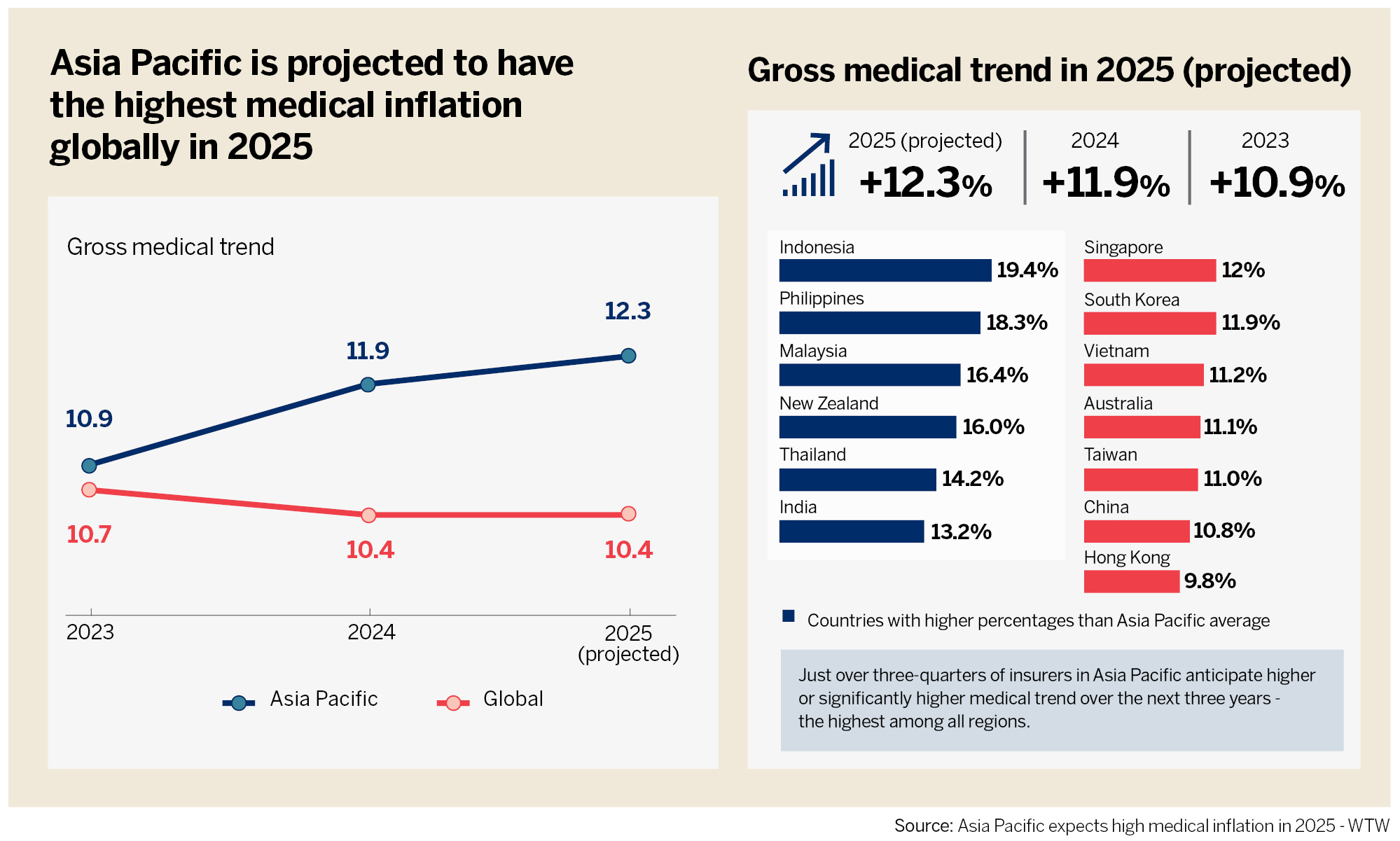
This surge is driven primarily by new medical technologies (73%) and the decline in quality or funding of public health systems (40%), shifting more financial risk onto individuals. Therefore, it is no surprise that employees are increasingly prioritising health-related benefits.
Recruitment expert Hung affirms this. He says, “Benefits that provide security, like medical coverage, help bridge that perceived gap between what people value and what they receive. Employees want their employer to acknowledge their whole life, not just their work. Medical benefits offer peace of mind for both individuals and their families.”
The priority on health also extends beyond medical coverage to self-care support. Leave entitlements and work-life balance programs consistently rank among the most valued benefits across Asia.
In Hong Kong and Japan, paid time off tops the list, while employees in India place the greatest importance on work-life balance programs. China, the Philippines and Singapore also reflect this dual preference, with PTO and work-life initiatives occupying the second and third spots, respectively.
Flex to fit
Flexible work has moved from a perk to a permanent status and employers who embrace it are winning big in talent retention and attraction.
LMA Recruitment’s Hung says, “From our 2024 data, 73% of employees ranked flexible working hours as a top driver of satisfaction and over half said that hybrid or remote options would make them more likely to stay.”
Yet a gap persists between employee desires and employer delivery. Findings from Reeracoen Group and Rakuten Insight Global’s Unveiling Workforce Aspirations Across Asia-Pacific show that while 72% of APAC employees want hybrid work options, only 46% currently have access.
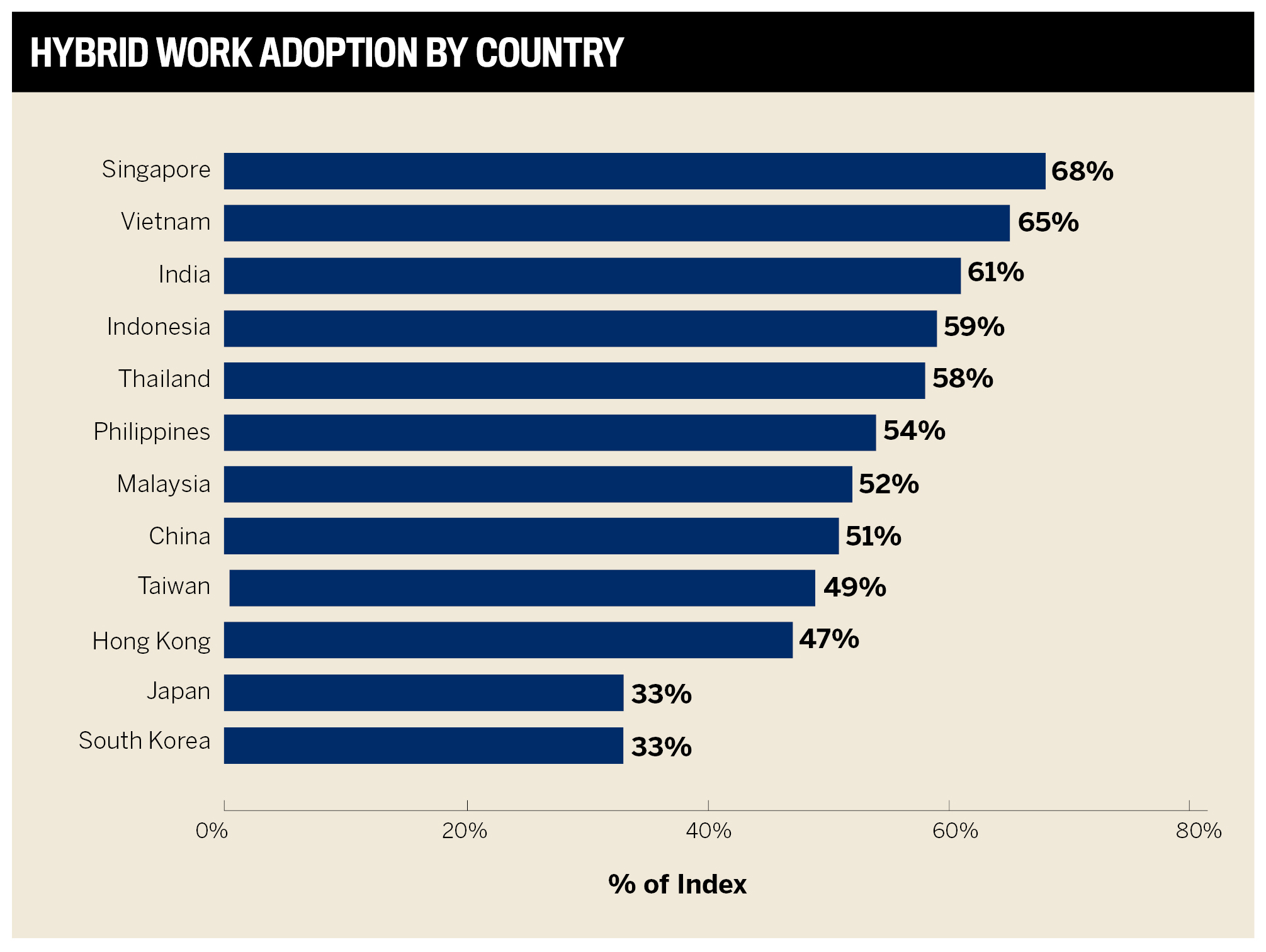
Singapore leads the region with 68% of employers offering hybrid arrangements, driven in part by government mandates requiring companies to consider flexible work requests. Vietnam (65%), India (61%) and Indonesia (59%) also show strong uptake, while South Korea and Japan lag significantly at just 33%.
For employers, the message is clear: flexibility is no longer just a differentiator but a baseline expectation.
Future-focused growth
There’s also an importance on supporting employees through the shifts reshaping Asia’s insurance industry.
“Our latest report shows the industry is undergoing rapid transformation, with digitalisation, regulatory reform and shifting customer demands reshaping roles,” says Hung. “Top employers in this space are not only competitive on salary but also help employees adapt through upskilling in areas such as AI, analytics, IFRS 17 and ESG reporting.”
Aon’s 2025 Employee Sentiment Study places career development fifth among the most valued benefits overall, but its importance varies across markets: ranking third in India, fourth in China and fifth in Singapore.
Similarly, the Reeracoen and Rakuten joint report highlights a strong appetite for learning-led progression and future-ready careers in Indonesia and Vietnam, where employees display some of the highest ambition index scores in the region.
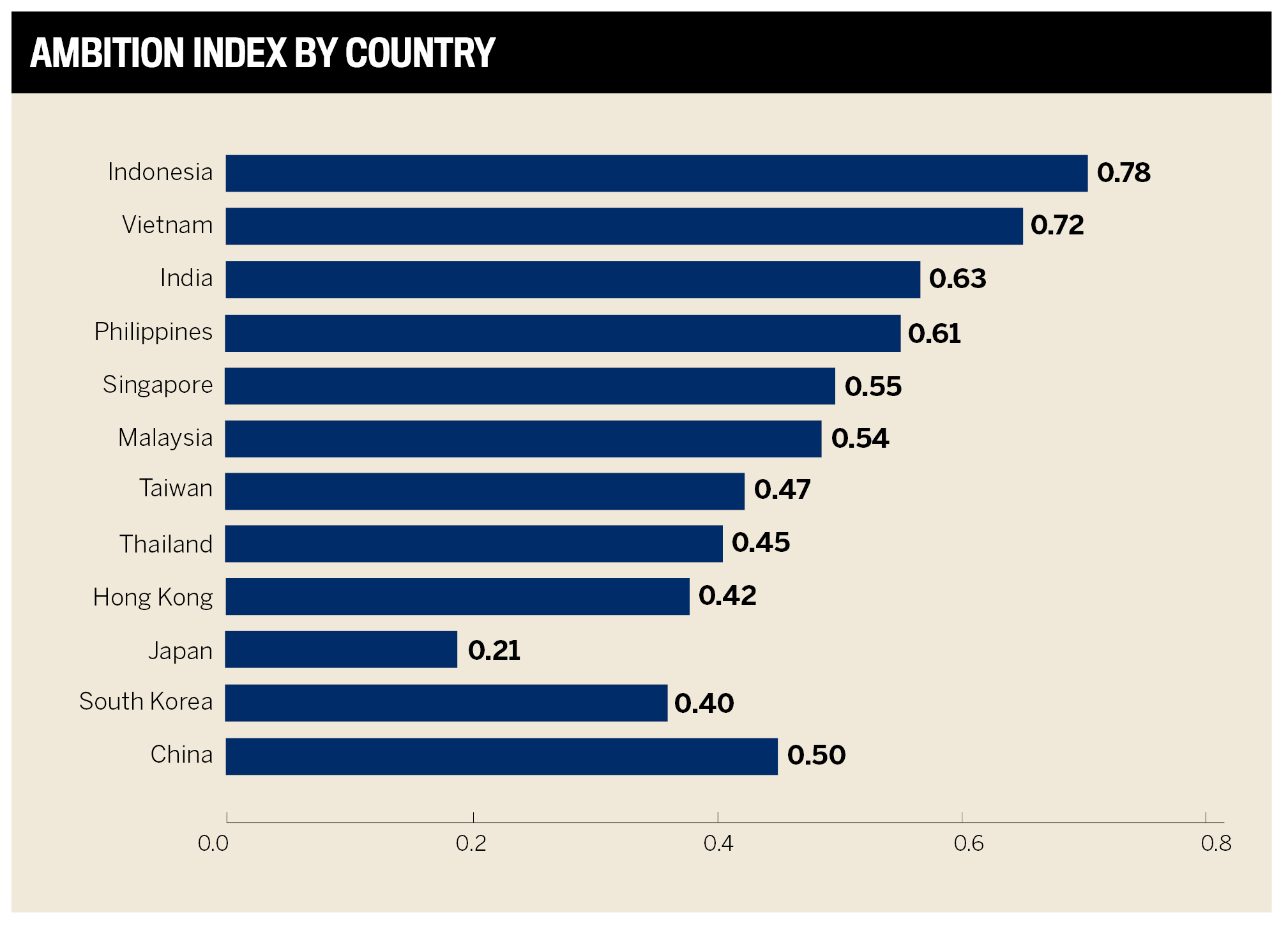
These preferences highlight a key shift: while competitive pay remains essential, employees want meaningful pathways to growth, especially in a sector shaped by advancing technologies and regulatory requirements.
At the same time, demographic realities amplify the challenge. Slowing population growth in markets such as Hong Kong, Macau, Singapore, South Korea and Taiwan means employers must do more with a smaller talent pool.
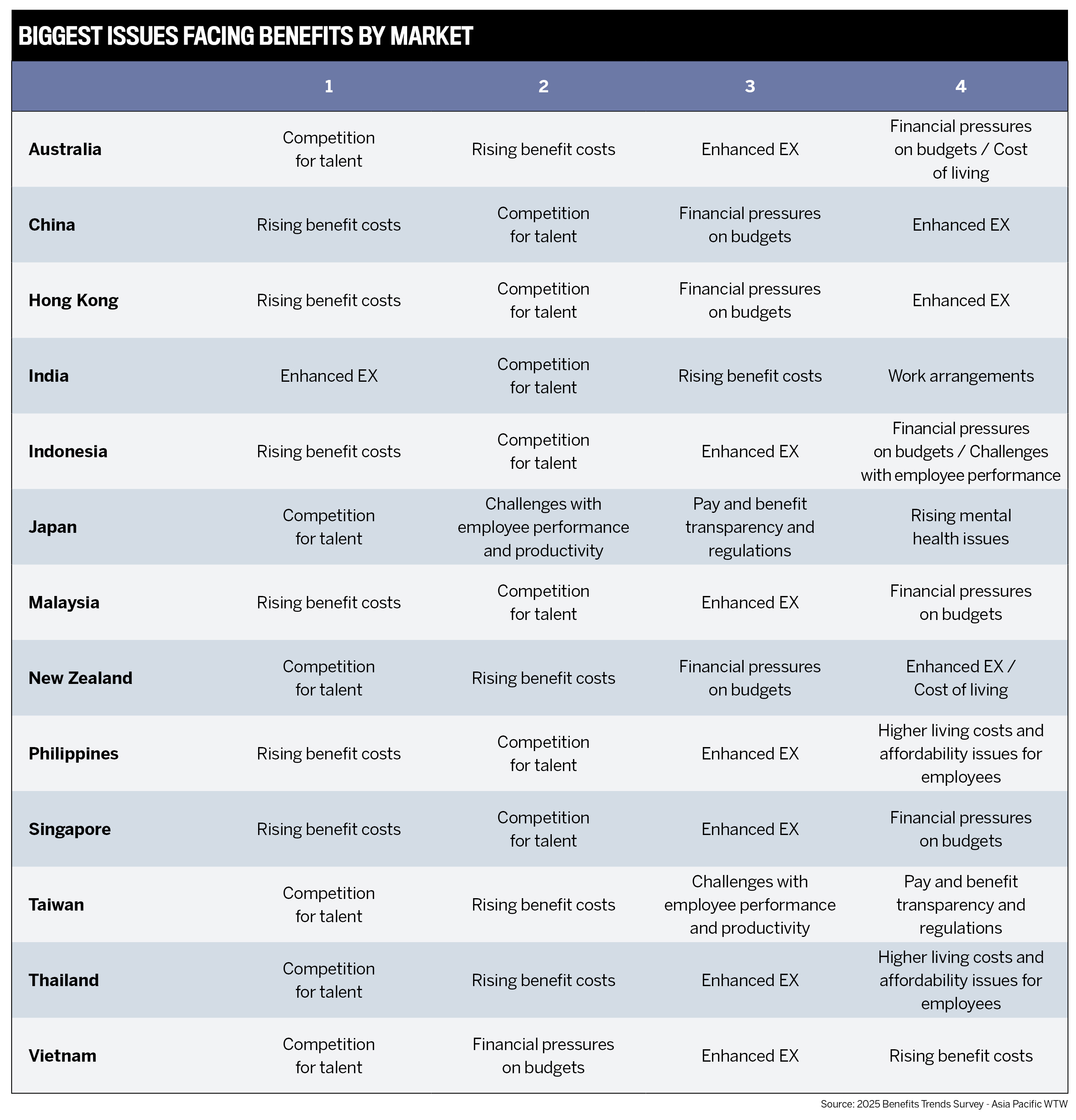
According to WTW’s 2025 Benefits Trends Survey, competition for talent remains the leading factor shaping benefit strategies across APAC.
In this environment, structured opportunities for upskilling and career development are no longer optional but rather a critical edge for employers in 2025.
Tracking the shifts
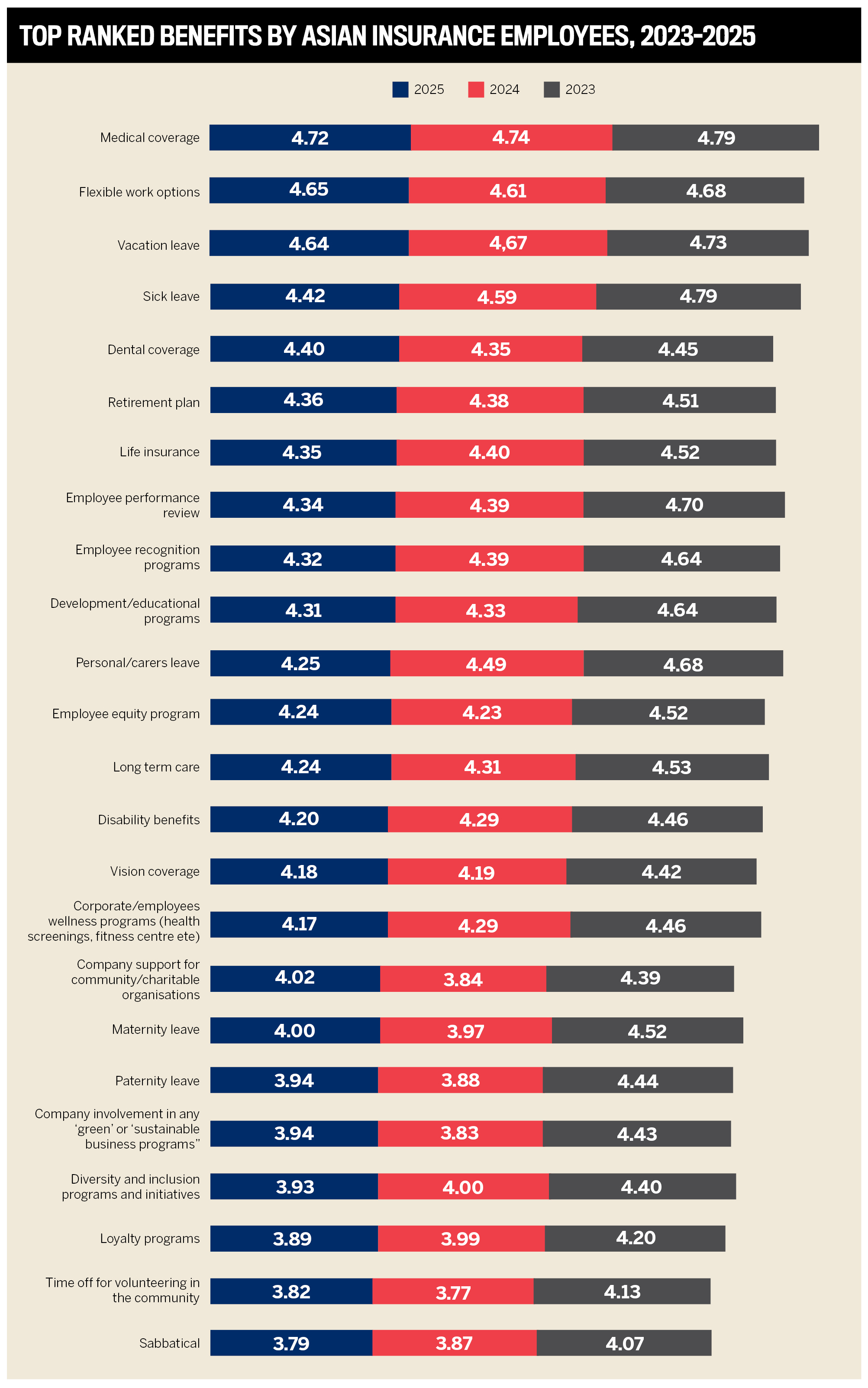
IB Asia annually surveys hundreds of insurance professionals across the region to identify what benefits they value the most from an employer. Benefits are rated on a scale of 1 (lowest) to 5 (highest).
Stable anchors
-
Medical coverage, flexible work and vacation leave dominate the podium year after year.
-
While there are slight score drifts, their constant placement underscores how these have become the non-negotiable of any leading insurance employer’s offering.
Benefits under pressure
-
Personal/carers, maternity and paternity leave all declined steadily. After surging during the pandemic and the recovery years, they are losing momentum, perhaps as employee expectations change.
-
Diversity and inclusion, sustainability initiatives, volunteering and recognition programs slipped in importance. Employees may be prioritising tangible impacts instead.
-
Once highly rated safety nets such as life insurance and long-term care also fell, displaced by the sharper priority given to medical coverage.
Notable 2024–25 shifts
-
Flexibility continued to rise, cementing its role as a must-have. Environmental and charity-linked initiatives edged upward, too, suggesting that while purpose-driven programs have generally slipped, employees still value them when they are concrete and tied to company action.
-
Personal/carer’s leave, wellness programs and recognition lost momentum, reflecting employees’ recalibration towards the essentials.
Similarity across all years
-
Core value items, including medical, time off and flexibility, consistently outrank “nice-to-have” programs.
IB Asia’s 2023–25 data to four clear dynamics shaping employee benefit expectations:
-
1. Essential protections dominate. Medical coverage’s consistent top ranking, even with slight score softening, confirms it is the baseline against which all else is measured.
-
2. Flexibility shifted from a perk to a principle. The 2025 rebound underscores that hybrid arrangements are here to stay. The post-pandemic workforce is not willing to roll back.
-
3. Wellness, DEI, and ESG face credibility gaps. The sharp slide suggests employees expect more tangible outcomes or see these programs as less impactful, possibly due to geopolitical and legal headwinds.
-
4. Upskilling is lagging. Declining scores for performance reviews and development signal either weak employer investment or employee fatigue with traditional PD offerings. With digital transformation and AI reshaping insurance, this gap represents a looming risk.
2025: in focus
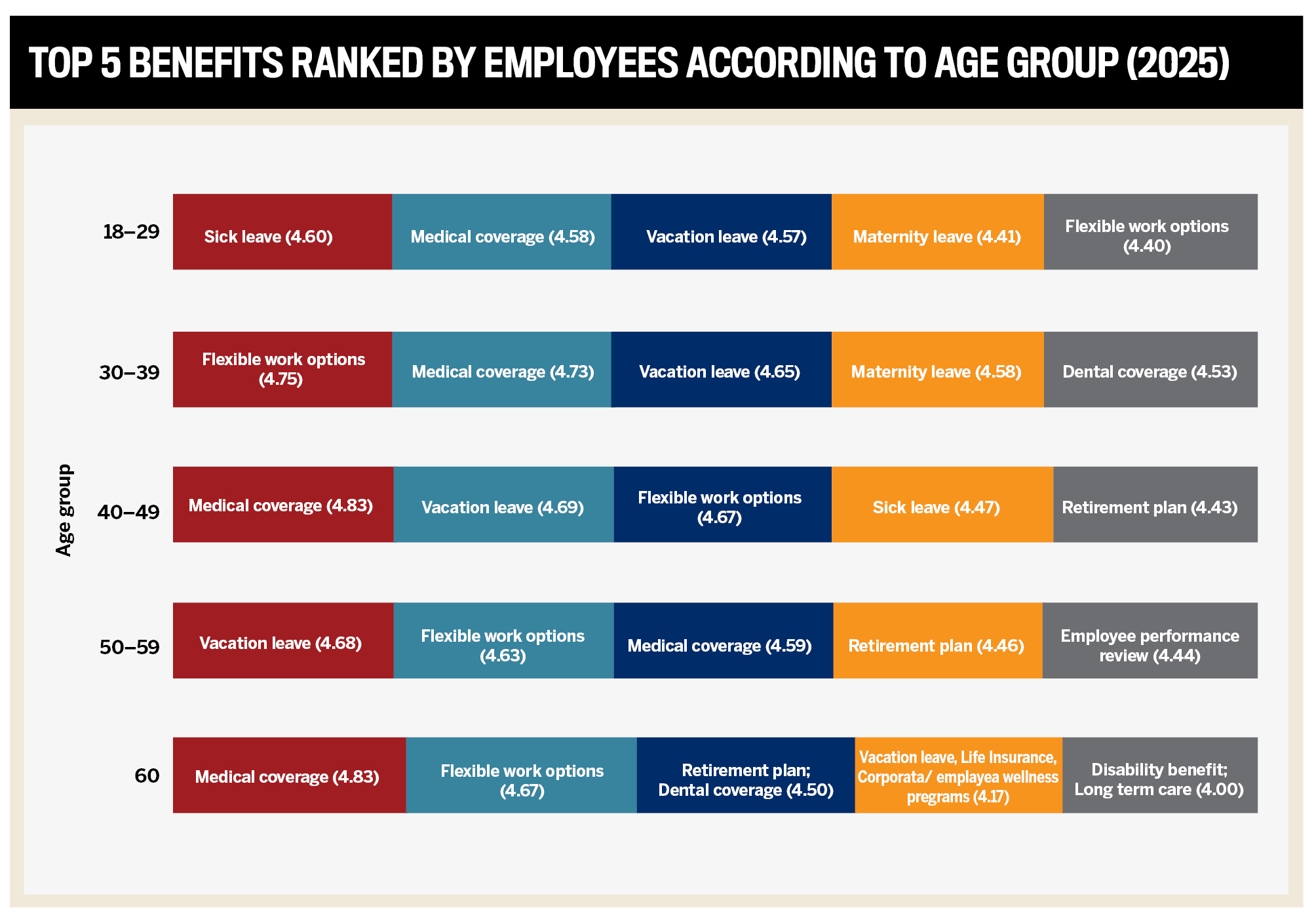
This year’s data reveals a layered picture when benefits are broken down by age, tenure and company size. While the fundamentals consistently dominate, the priorities underpinning them shift in telling ways.
Across all cohorts, similar essentials – medical coverage, paid leave and flexible work – emerge as the baseline expectations, reinforcing the broader three-year trend that core protections outweigh discretionary or symbolic perks.
Where the cohort diverges is in the secondary benefits they prioritise. Younger professionals lean towards sick leave and parental support, while mid-career employees place more emphasis on flexibility and career development. By contrast, older workers shift their focus decisively towards retirement and health security.
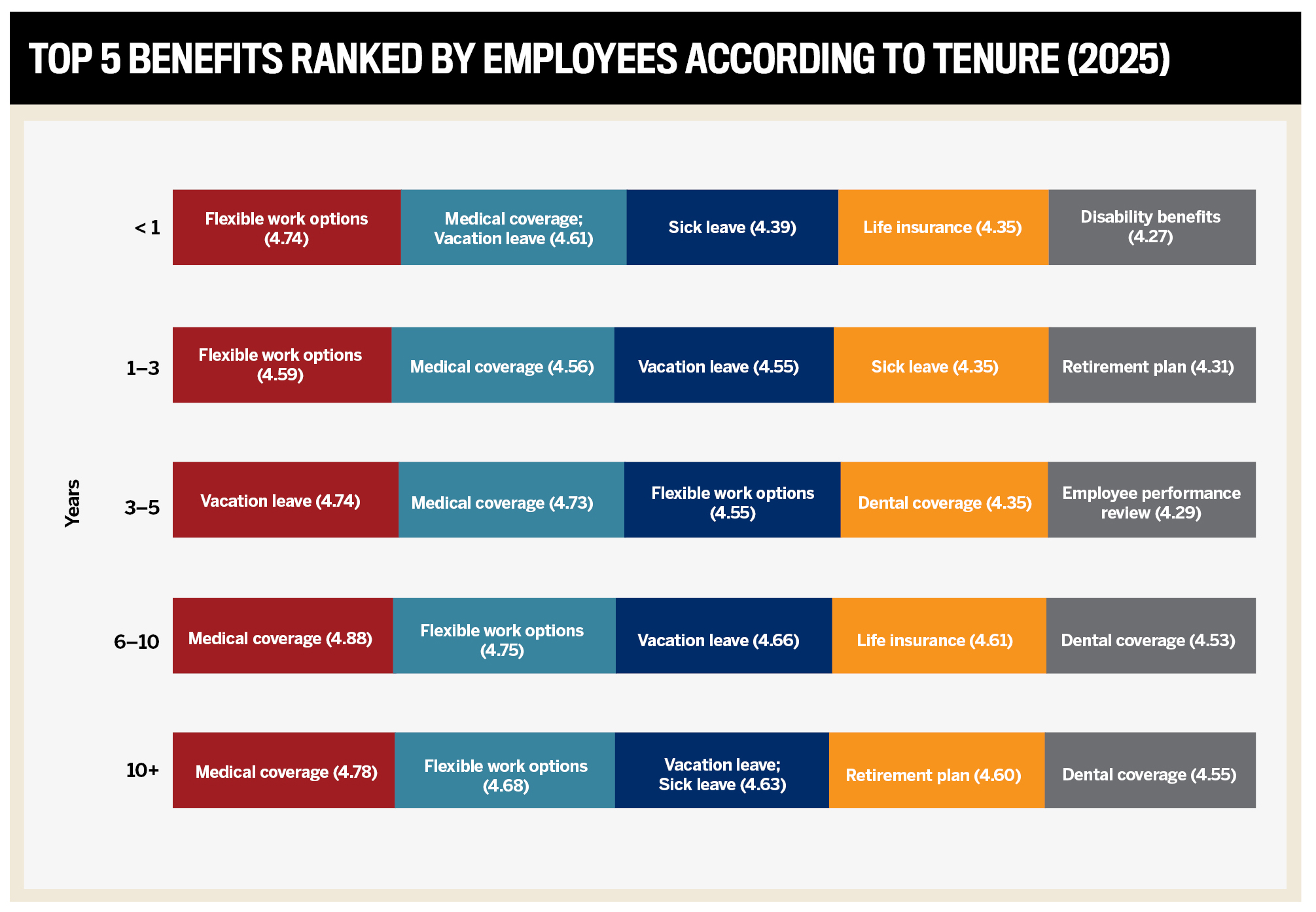
A similar progression emerges with tenure: newcomers value flexibility and immediate protections, mid-tenure staff look for recognition and advancement, while long-serving employees gravitate towards stability through retirement and medical benefits.
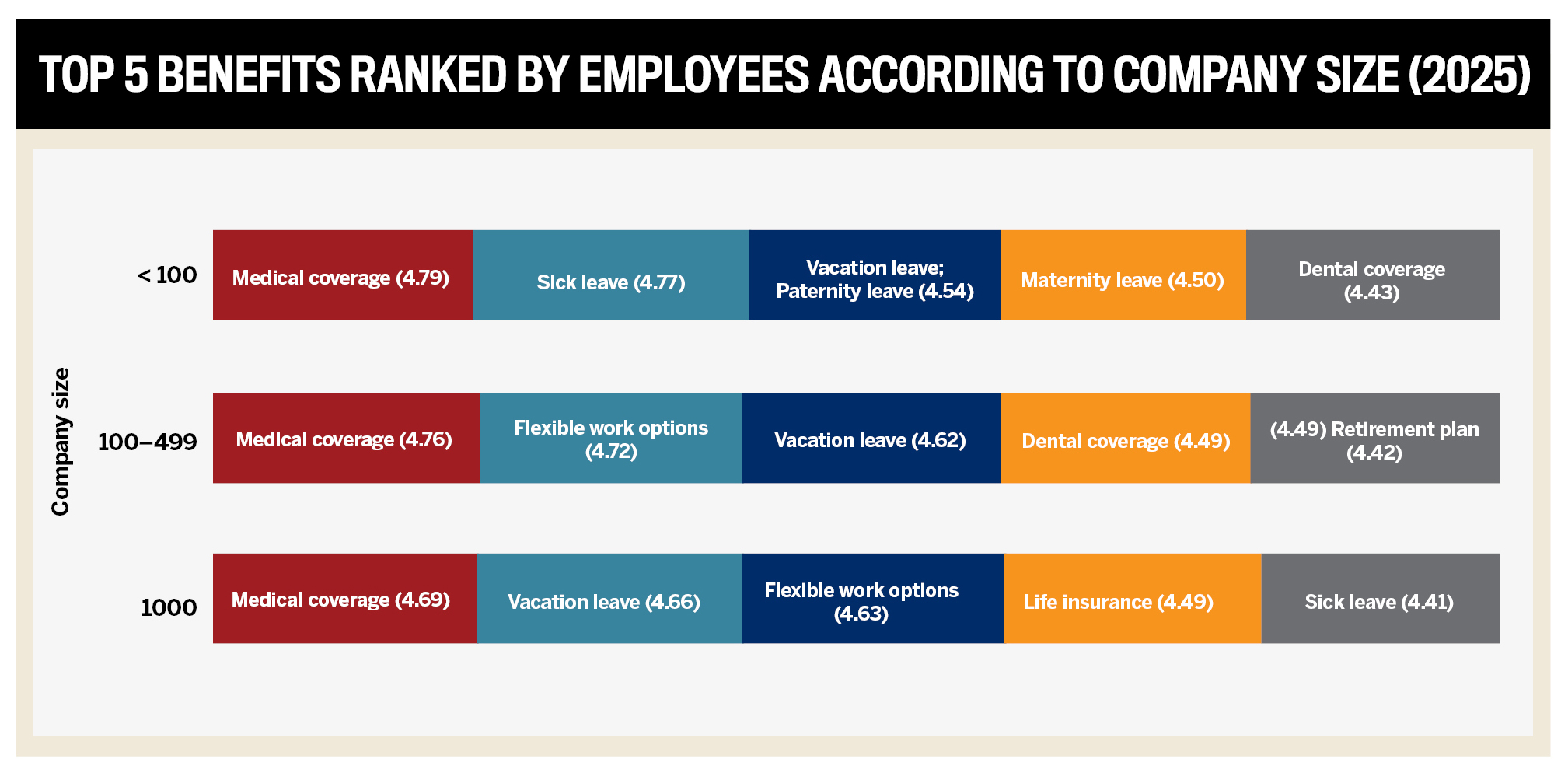
Company size introduces further nuance, with small-firm employees seeking family-focused protections, mid-sized firms aiming for a balanced mix and larger organisations expected to deliver structured career benefits alongside the essentials.
Shifting loyalties, sharper choices
Globally, 60% of employees are either in the process of moving employers or are planning to jump to a new job opportunity in the next 12 months, according to Aon’s 2025 Employee Sentiment Study.
Some countries across Asia recorded rates surpassing this average:
-
India: 82%
-
Singapore: 67%
-
Philippines: 64%
-
Hong Kong: 63%
IB Asia’s data mirrors these mobility trends but with an interesting progression from 2023 to 2025. Almost a quarter of respondents said they would consider changing employers for better working conditions, suggesting that loyalty was still the default in 2023.
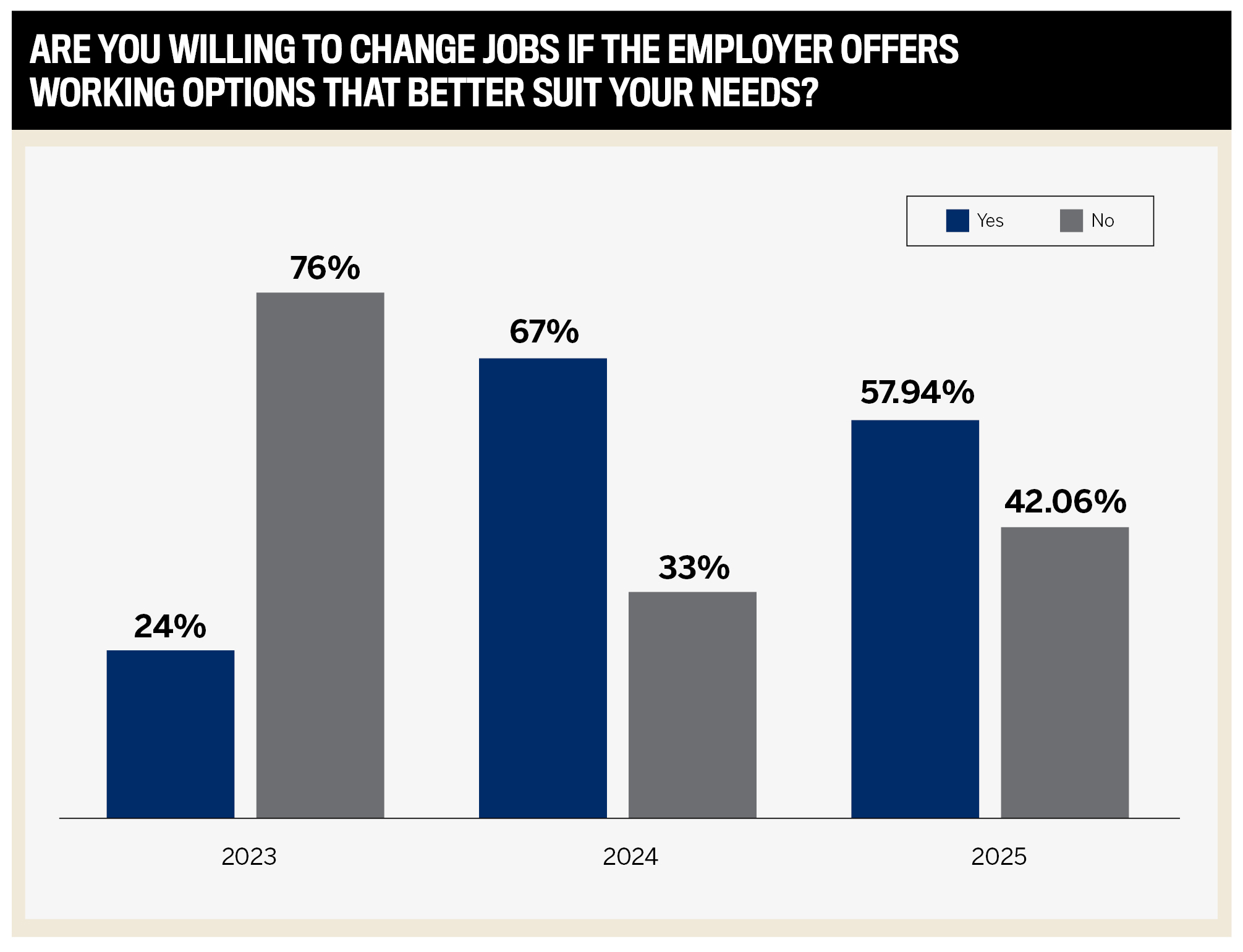
By 2024, that figure had nearly tripled, reflecting a sudden surge in employee willingness to walk if expectations were unmet.
This year, however, numbers have moderated, settling closer to the middle ground. Employees are no longer making decisions on impulse but are weighing their options more carefully, balancing their desire for improved conditions with stability and long-term benefits.
For employers, this evolution signals both risk and opportunity. The sharp spike in 2024 warns how quickly talent can leave when expectations are ignored. By contrast, the 2025 adjustment points to a more discerning workforce that is still mobile but seeking employers who can offer more than short-term fixes.
The bigger picture
IB Asia’s data underscores that benefit expectations among Asia’s insurance professionals are not static but shift with life stage, tenure and company size.
The consistent thread is pragmatism: employees place the highest value on benefits that directly affect their health, time and security, while adjusting their secondary priorities as their personal and professional circumstances evolve.
IB Asia’s Top Insurance Employers 2025
The insurtech’s employee-approved workplace culture is built with purpose. DEI is embedded in daily work practices, from hiring to developing and supporting talent.
Group chief people officer, Scott Austin, says, “Our overall work is very much focused around principles of performance, care, balance, trust, belonging and enablement. When you start thinking about DEI with those different lenses, it creates the opportunity for people to think differently about their work.
“I’m most proud of my team because I’ve got some well-seasoned people who bring great experience and skills. Our director of diversity and inclusion has had 30 years of experience doing it.”


Scott Austinbolttech
This standard of expertise allows bolttech to seamlessly link inclusion to leadership programs and support designs effectively, especially around the firm’s AI-driven changes. Employees are guided and supported through a comprehensive suite of AI literacy courses, town hall updates and coding assistance with their technology teams.
“Some work is going to go away because it can be done by AI, but it allows us to start having conversations about what other things employees could be doing and how we reshape roles,” Austin says. “It comes down to looking at how we make sure we take the scariness away from AI. There’s a lot more to do around how we build that across the group. I feel like we’re headed in the right direction with the leadership that we’ve got.”
The firm’s recognition is no accident but a product of its collaborative culture and high-trust environment.
Charlotte Ang, head of human resources, Asia, says, “I give kudos to the strong leadership team who always includes HR from the start, which shows how much they value our employees.”
Ang credits AXA XL’s collaborative environment to their open-door policy. “Our leaders are not seated in offices. It’s like hot desking, and there are no barriers to reaching out to leaders, as they are seated among the employees,” she explains. “Our leadership always emphasises: Don't work in silos. Collaborate as a team. Cooperate as a team.”

Charlotte AngAXA XL
This commitment to openness extends to transparent internal communication. Employee feedback takes front and centre in the biannual Pulse Survey and town hall sessions, where at least half the time is allocated to answering employee queries.
No concern is too small for the team to address. Ang adds, “When we moved to hybrid working, our employees asked for a basket to bring their things from their locker to their desk, and we did that. We are open to improving even the small things.”
Investing in employee growth and mobility
Another defining aspect of AXA XL’s employee experience is its focus on professional development. Employees are encouraged to dedicate one hour each month to learn any skill they want to acquire.
High-potential employees participate in a structured 12-month program combining bespoke development plans, professional coaching and tools like CliftonStrengths assessments to stretch their capabilities.
AXA XL offers opportunities for employees to transition across business lines. Ang says, “We explore opportunities for those willing to grow. We always tell our employees: your managers don’t own your career; you own your career.”
Top employers deliver on what matters
Both winners share how they champion the benefits and experiences that make a difference.
How have you structured medical coverage for your teams?
Austin – bolttech: “We appointed a global partner to help us benchmark, design and negotiate with insurance providers on medical and risk benefits locally. We have developed a Global Benefits Framework covering all core employee benefits categories, including medical benefits. We look at what’s going on in our various locations and try to align to local markets.”
Ang – AXA XL: “We do cover inpatient, outpatient, dental, term life, personal accident and critical illness up to 12 months, which is something not commonly covered. In terms of health checks, employee can go for an annual health screening. The company subsidy helps and encourages people to go.
“If someone is diagnosed with a medical condition and needs a second opinion, we do pay for the cost. It's covered in our extended insurance benefit.
“We also provide coaching for people returning to work after a long medical leave. Coming back to work can be quite challenging, so we offer three 45-minute sessions of coaching, done by an external consultant. Employees can start the coaching even before they return to ensure a smooth transition.
“Our medical coverage also extends to the employees’ dependents. In addition to our insurance package, we also give a lump sum that employees can spend either for sports and recreation, vaccination or even dental for their family.”
What does flexible working look like at your firm?
Austin – bolttech: “There is no enforced return to office mandate. We have options like part-time, job-share, compressed hours, varied start/finish times, parental leave, career breaks and unpaid leave.
“Flexibility is not something that’s going to go away for us. I find that it helps keep people here. I've got stories of people who left when they became parents and came back because now, they can go and pick up the kids from school and still be able to jump online and do things later in the evening.
“We have a caring perspective that allows our people to flex around, whether it’s children, aging parents or partners. We try to shape and build a culture where our team can talk to us about what’s going on in their lives.”
Ang – AXA XL: “A lot of companies are asking employees to come back to the office full time, but we have maintained our three days in the office and two days work-from-home setup.
“We educate our managers and have sessions with them on how to manage employees in this setup. Individual teams discuss amongst themselves; they agree on the days they come in together, connect and have face-to-face meetings. We trust our employees to manage their own time.”
How do you support employee rest and wellbeing?
Austin – bolttech: “We partner with Optum for 24/7/365 free, confidential counseling and coaching for employees and immediate family members.
“We run regular monthly sessions around a range of different topics like parenting and mental health. We have had some physios to talk about stretching, movement and healthy eating.
“We also provide premium access to Calm, an app that provides guided meditation, breathwork, stress-reduction exercises, sleep content and short mindfulness sessions designed for daily use.
“I have regular conversations with different people about how they can access those services. Sometimes it’s just about trying to help prioritise workload, equipping them with tools and giving them confidential, outside support.”
Ang – AXA XL: “We came up with guidance on how employees can disconnect. After work hours and on weekends, no emails. We encourage them to take breaks and respect personal time. Our leaders always reinforce this message in meetings or town halls to make employees feel that it is okay to disconnect.
“We also have our Employee Assistance Program. It’s a 24/7 phone service to support mental health and comes with six sessions of coaching.
“We have a Healthy You Week in October, which runs in parallel with World Mental Health Day, where we have talks on physical and mental health.”
Conclusion
IB Asia’s prestigious Top Insurance Employers 2025 list captures how the standout leaders are shaping the industry amid demographic shifts and accelerating market changes by:
- going beyond perks at the margins to the fundamentals that matter the most to employees.
- doubling down on the essentials to secure loyalty and position themselves at the forefront of the industry
The Best Insurance Companies to Work for in Asia |
Top Insurance Employers


100 – 499 employees

Less than 100 employees
- Finology Sdn Bhd
Insights
-
 Jean Pierre Hung
Managing Director
LMA Recruitment
Methodology
To find and recognise the best employers in the industry, Insurance Business invited organisations across Asia to participate by filling out an employer form outlining their various offerings and practices. Next, employees from nominated companies were asked to complete an anonymous form evaluating their workplace on a scale from 1 (poor) to 5 (excellent) on various metrics, including benefits, compensation, culture, employee development and commitment to diversity and inclusion.
To be considered for the final list, each organisation had to reach a minimum number of employee responses based on its overall size. Organisations that achieved a 75% or greater average satisfaction rating from employees were named Top Insurance Employers for 2025.
Keep up with the latest news and events
Join our mailing list, it’s free!