
Best Insurance Companies to Work for in Australia and New Zealand | Top Insurance Employers
Jump to winners | Jump to methodology
Retention leaders
Employees singled out the best insurance companies to work for in Australia and New Zealand as those that invest in what people genuinely value. These employers stand out for their consistency in how they support staff, both on and off the job.
At Australian specialist recruitment agency Fuse Recruitment, an April 2025 survey of its extensive database of insurance candidates found that work-life balance and culture have overtaken traditional priorities such as salary and advancement.
National manager of insurance and wealth management Madeleine Martin says, “Salary still ranked as being of highest importance, but it was very closely followed by work-life balance and company culture.”
She noted this reflects years of industry talent shortages, where the pressure has mounted on existing employees, and it has come at the cost of manageable workloads, flexibility, and wellbeing for many.
“We suggest that, in the past, a clearly defined career path, company reputation and a suite of financial benefits were the qualities that insurance employees were seeking,” Martin adds. “In the current market, flexibility, work-life balance and wellbeing have been reprioritised and are now having a large influence over employee experience.”
Insurance Business’ Top Insurance Employers 2025 survey analysed five core strengths among this year’s winners:
-
Inclusive cultures: Many described their teams as collaborative, respectful and low-ego. What stood out was how often people mentioned kindness, shared values and a sense of belonging. For them, inclusion comes through in how people treat each other. Martin noted that culture is not a nice-to-have; it’s a reason people leave. She says, “Two of the main reasons that candidates were motivated to change jobs was company culture and poor leadership.”
-
Flexibility backed by trust: Hybrid schedules and remote work were common, but what mattered more was not being micromanaged. Employees said they appreciated the autonomy to do their jobs without being second-guessed.
-
Growth that goes somewhere: Respondents talked about getting support in different ways. Some mentioned formal leadership programs, and others just appreciated a manager who checked in and offered direction. What stood out was the sense that the company wanted them to move forward and gave them the tools to do it.
-
Feedback that doesn’t disappear: Employees noticed when they were asked for their opinion, and it led to something. A few said they’d seen fundamental changes after raising issues in a survey or team meeting. Even small shifts made it clear their input counted.
-
Wellbeing made tangible at work: Plenty of employees pointed to EAPs or wellness days, but what stuck with them were the small signs of care: time off when it mattered, a check-in from a manager or just the space to deal with life when needed. What made it count was that it felt genuine.
Australian respondents in Randstad’s Workmonitor 2025 reported higher-than-global access to flexibility. Seventy-two percent said their jobs provided flexible hours, and 64% cited flexibility in location, well above the global average. These numbers suggest that flexibility is valued and employers are delivering in meaningful ways.
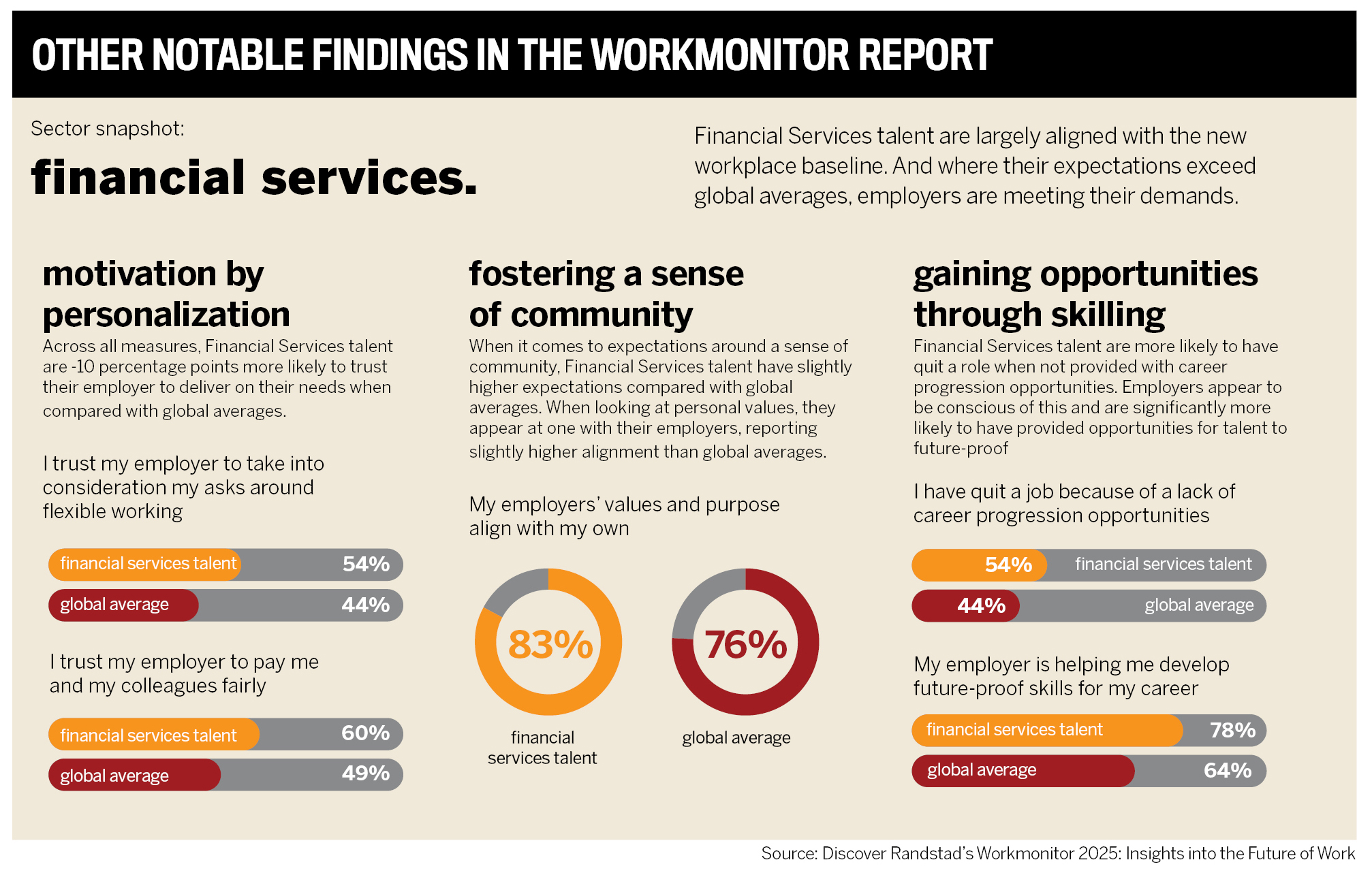
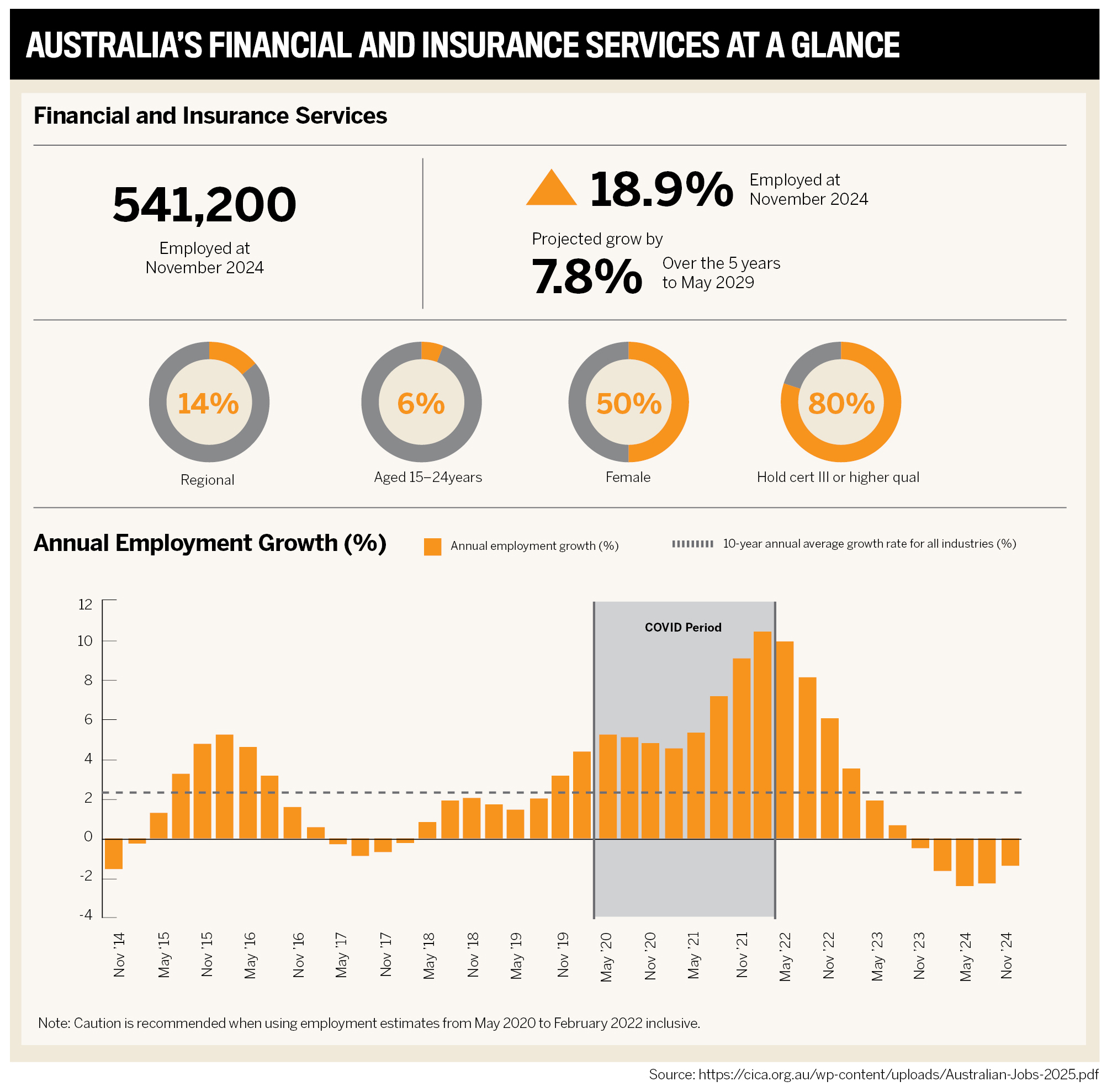
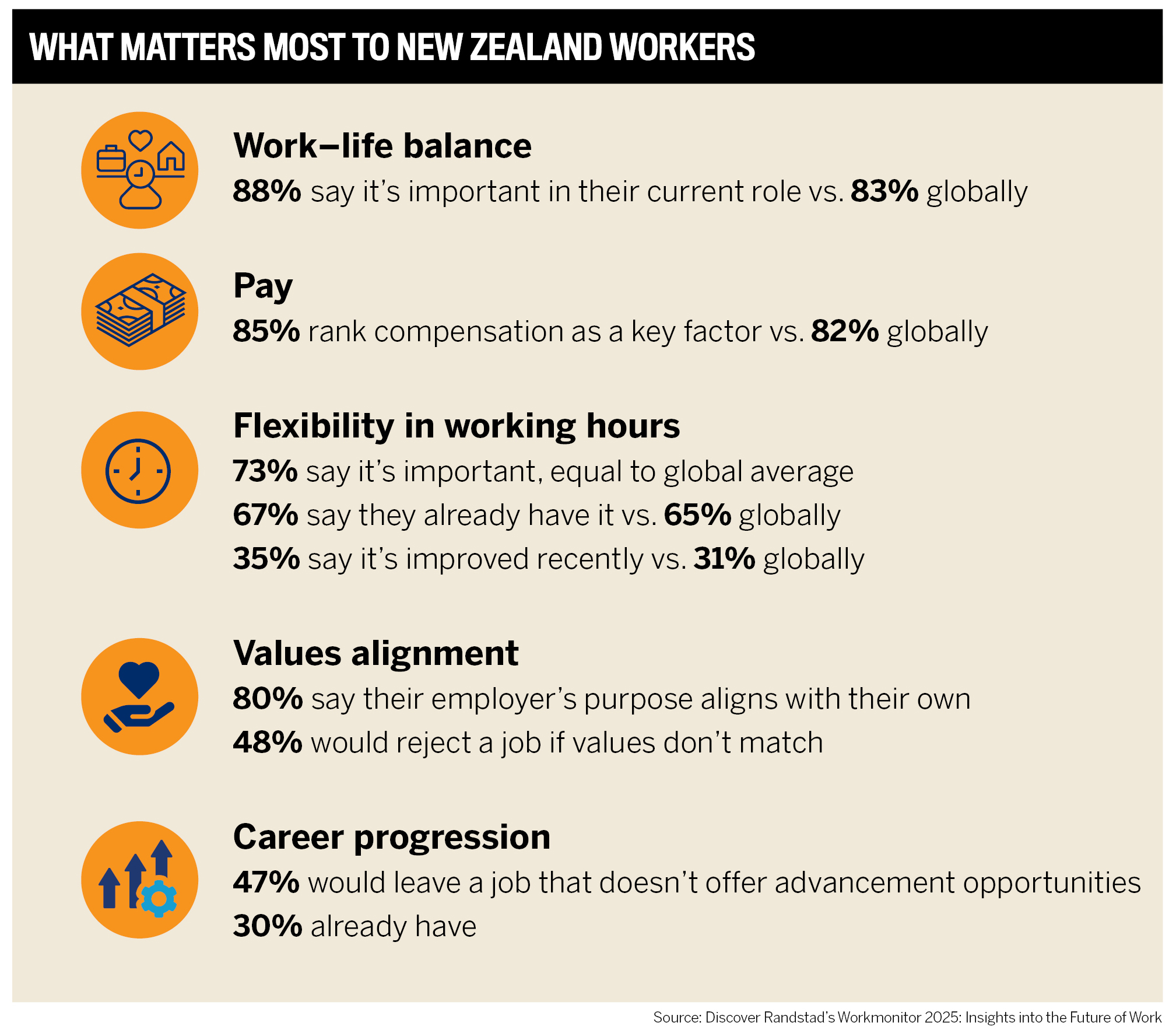
According to Randstad’s Workmonitor 2025 report, 67% of New Zealand-based workers said their jobs offered flexibility in working hours and 58% said they had location flexibility. Those numbers are on par with or slightly ahead of global averages. But what stands out is momentum, as 35% of employees said their flexibility had increased in the past six months, suggesting a shift that continues to benefit workers.
New Zealand employees also echoed the sense of connection evident in IB’s data, with above-average trust in leadership and a stronger-than-global need for workplace community. This supports what respondents described as cultures where people could be themselves, collaborate openly and rely on one another.
Fuse Recruitment works with companies of all sizes across Australia’s insurance industry and Martin has observed the following characteristics that stand out to its candidates:
-
clear, uncomplicated vision and a set of values, combined with a healthy and happy workplace
-
various short-term benefits that focus on work-life balance and wellbeing
-
long-term, personalised development plans
-
culture that embraces change and emerging technology
The agency’s candidate survey found that 79% said it was important for their employer to embrace AI and advance their use of technology. However, only 18% felt prepared for the rise of AI and automation in the industry.
“As AI has crept into the workplace over the past one to two years, employees have been eager to develop their knowledge and skills so that they don’t feel left behind,” she reflects. “If an employer isn’t looking to introduce AI and other emerging technology into their workplace, they risk losing some of their more tech-curious employees who will consider moving companies to build critical skills.”
To identify the best insurance employers in Australia and New Zealand, IB sought submissions from companies outlining their benefits and workplace practices. Employees then completed anonymous surveys rating their experience across key areas such as culture, compensation, development and inclusion.
Only firms that met a minimum response threshold were considered. Those with an overall satisfaction score of 75% or higher earned a place on the prestigious 2025 list.
The benefits that move the needle
IB’s data shows that employees rated vacation leave, sick leave and flexible work options the highest, scoring over 4.5 out of 5. These results suggest that time off and autonomy are now non-negotiable in a competitive job market. And the impact goes beyond morale.
According to the McKinsey Health Institute, investments in wellbeing could unlock up to US$11.7 trillion in global economic value. Even a one-point boost in employee happiness can be tied to US$2.3 billion in profit.
Fuse’s Martin says there’s been a focus in Australia on ensuring that employers are prioritising the overall wellbeing of their employees through benefits such as EAPs, health subsidies, fitness allowances, wellbeing leave and in-office wellness initiatives – common features candidates now look for.
McKinsey also links stronger employee wellbeing to six core business outcomes:
-
higher retention
-
lower absenteeism
-
improved productivity
-
stronger employer brands
-
reduced healthcare costs
-
enhanced ESG credibility
This global view echoes what IB’s survey data shows locally. Among nearly 700 respondents, flexibility and time off ranked higher than wellness programs or medical coverage. Employees prioritised the freedom to manage their workload and time to recharge.
Professional development and recognition still matter, but employees want growth on their terms through opportunities that line up with personal goals.
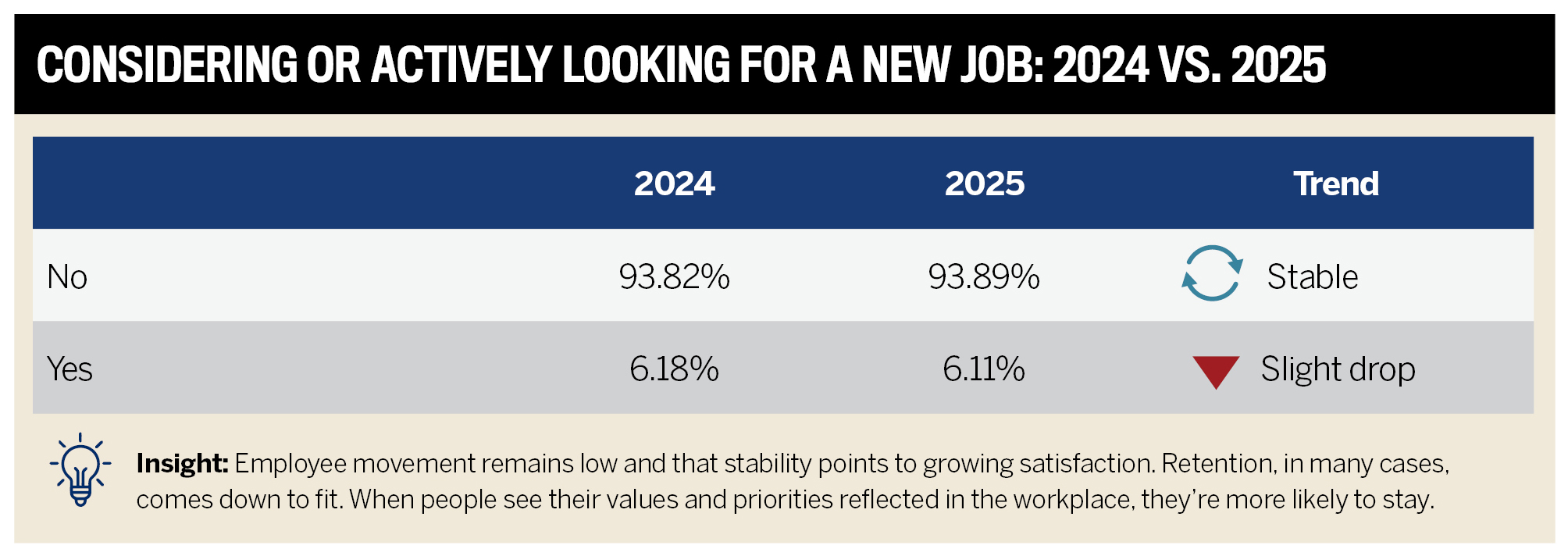
Fewer than 7% of employees said they were looking to leave in 2024 and 2025, a sign that employers are largely meeting expectations. Initiatives such as sustainability and volunteering help a company’s reputation, but they’re not what attracts talent.
How Aussie and Kiwi employees compare globally
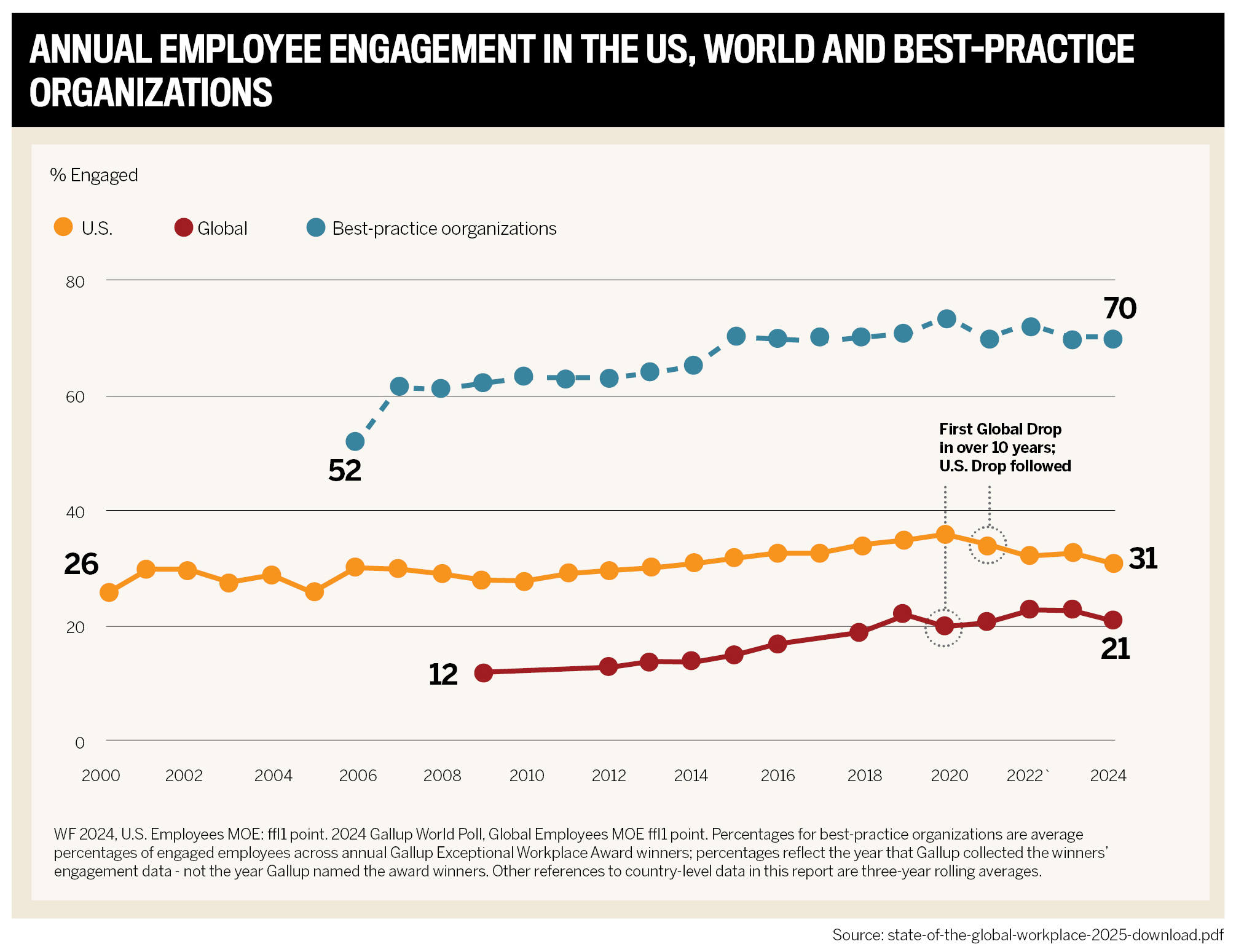
The impact of high employee engagement is staggering. According to Gallup’s 2025 State of the Global Workforce, if every workplace reached full engagement, it could add US$9.6 trillion in productivity to the global economy, the equivalent of a 9% bump in global GDP.
Against that backdrop, Australia and New Zealand are punching above their weight. The region ranks sixth globally for engagement, with 23% of workers engaged (compared to the global average of 21%) and a leading 56% saying they’re thriving, alongside the lowest levels of daily loneliness and the highest optimism about job prospects.
That context helps explain why the region’s best insurance companies to work for stand out. These firms offer comprehensive benefits and build environments that foster purpose, reduce burnout and support long-term growth.
Other Gallup findings show Australia and New Zealand workplaces caught between strain and renewed optimism, a reality employers would be wise to watch:
-
49% report daily stress – among the highest globally, just behind the US and Canada
-
15% experience daily anger, well below the global average of 21%
-
72% believe it’s a good time to find a job, far above the worldwide average of 51%
-
42% say they’re not looking to move – a signal of workplace satisfaction that exceeds global norms
IB’s data: a year-on-year snapshot of employee priorities
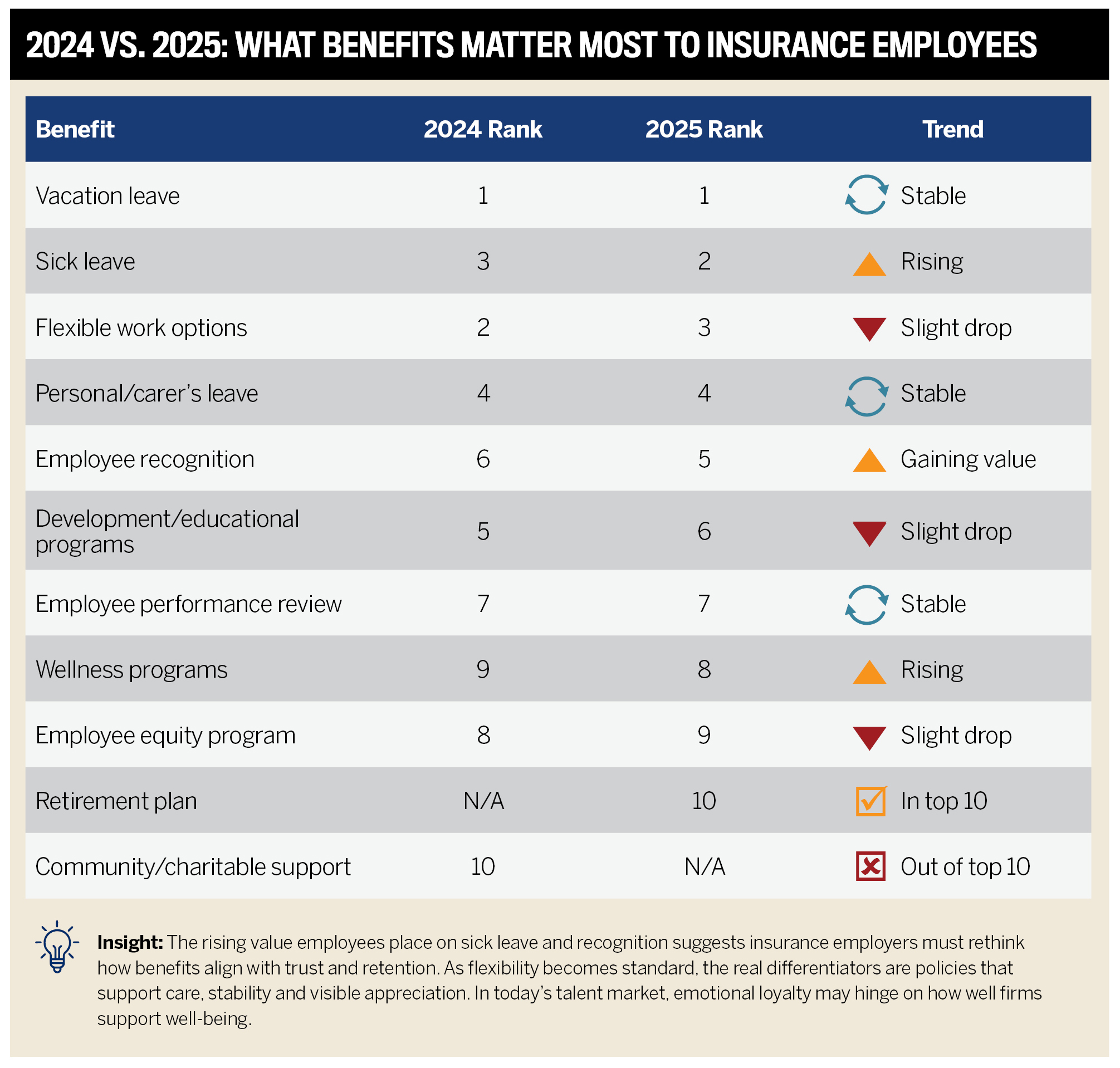
The fundamentals haven’t changed, but people are sketching out clearer boundaries around their priorities. Across 2024 and 2025’s Top Insurance Employers survey, the benefits people cared about most were vacation time, sick leave and flexible hours. This year, sick leave edged ahead, emphasising a stronger focus on health, job security and being part of a caring workplace.
Recognition also climbed the list. It moved from sixth to fifth place, showing that more employees are looking for genuine appreciation, not just the occasional shout-out.
Development dropped slightly, which doesn’t mean growth has stopped mattering. But it suggests people prioritise rest and emotional wellbeing more than they used to
Wellness programs saw an uptick, too. What stood out wasn’t big launches or fancy perks, but support that feels useful and real. Still, their relatively modest ranking hints at a shift in how people define wellbeing at work as how they feel each day.
Community and charitable programs dropped out of the top 10 this year, replaced by retirement plans, which suggests a growing focus on long-term security in an uncertain economy.
Time off and flexibility are still critical, but what’s rising fast is something harder to quantify: psychological safety and authentic human connection. That’s what’s shaping how people judge the quality of their workplace and whether they stay.
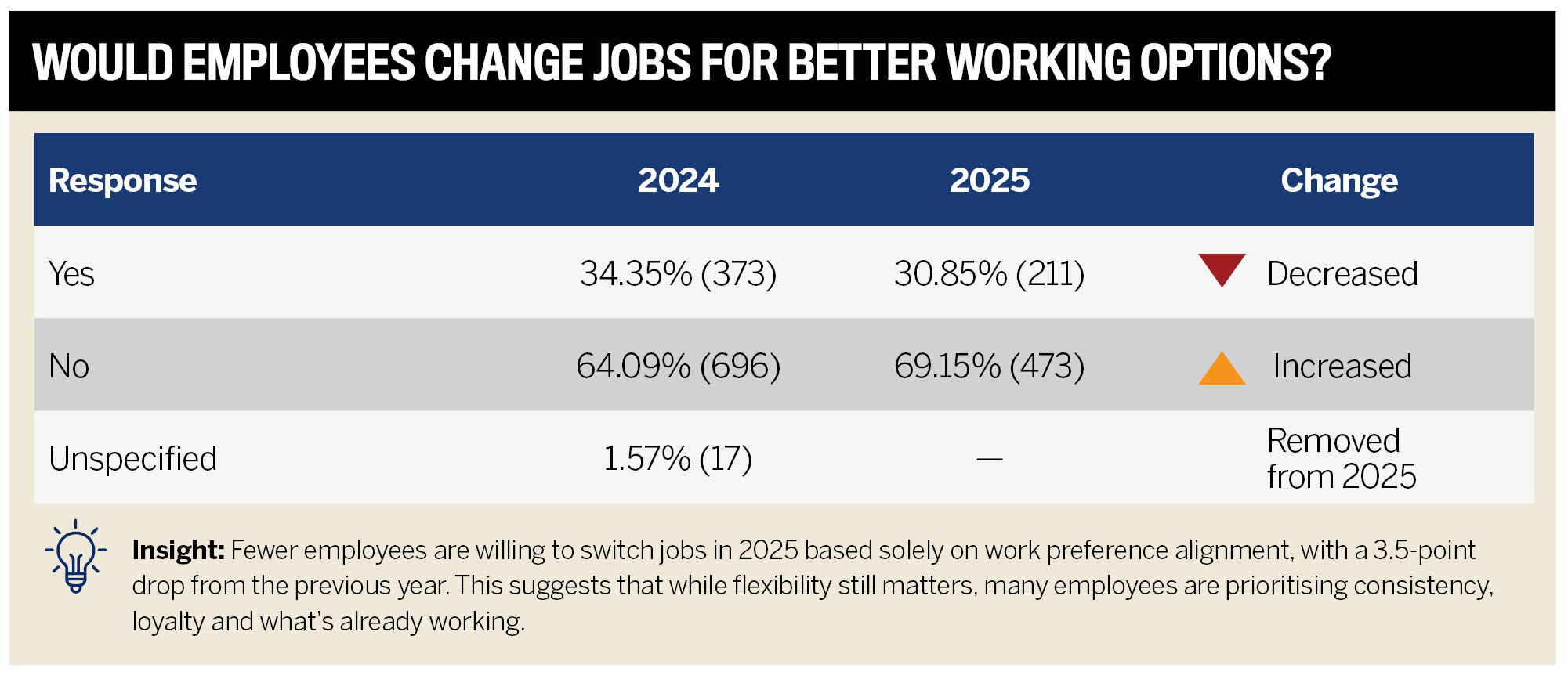
Willing to walk? Fewer insurance employees say yes in 2025
Last year, over a third of employees said they’d consider switching jobs for better working conditions. That number dropped in 2025. Now, 30.85% say they’d move for a better setup, down from 34.35% the previous year.
Meanwhile, the share of employees staying put has grown. This year, 69.15% said they wouldn’t consider a switch, a jump of more than five percentage points. It suggests a growing appetite for stability after years of workplace shakeups, especially now that flexibility is commonplace in many roles.
After so much change, insurance professionals may focus less on chasing marginal gains and more on sticking with what works. It’s the sign of a workforce that feels more settled and less likely to move unless the opportunity truly stands out.
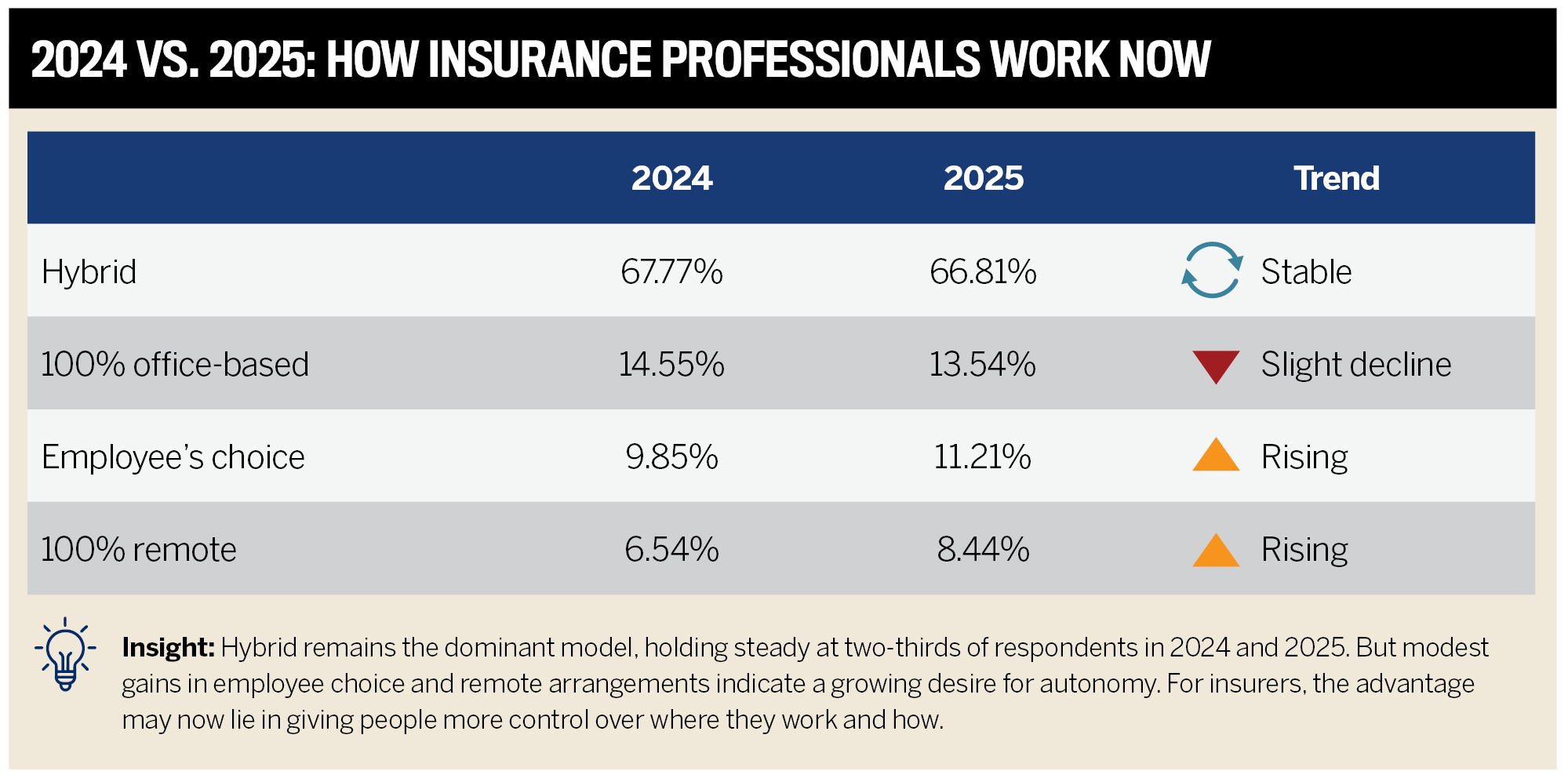
Employees want control, not just flexibility
Hybrid work is still the norm in insurance, and the numbers haven’t moved much since last year. But there’s a subtle shift happening in that more employees are leaning into remote setups or choosing arrangements that give them more say. The trend isn’t huge yet, but it’s telling. Flexibility on its own isn’t cutting it. People want control.
Firms that default to rigid hybrid structures, such as set office days or narrow location rules, may start to feel out of step. In a field built on consistency, giving employees more say in how they work could be the next competitive edge.
Fuse’s candidate survey also showed that 75% of respondents were still working under a hybrid arrangement of at least one day working from home each week.
But Martin cautioned that if insurers roll back hybrid options, they may find that they risk turnover as a result and attracting new employees would likely become more difficult than it already is in a talent-short market.
“Hybrid work is here to stay and in order to attract the best talent in the market, a full suite of benefits needs to be on offer, and that includes hybrid working arrangements,” she adds.
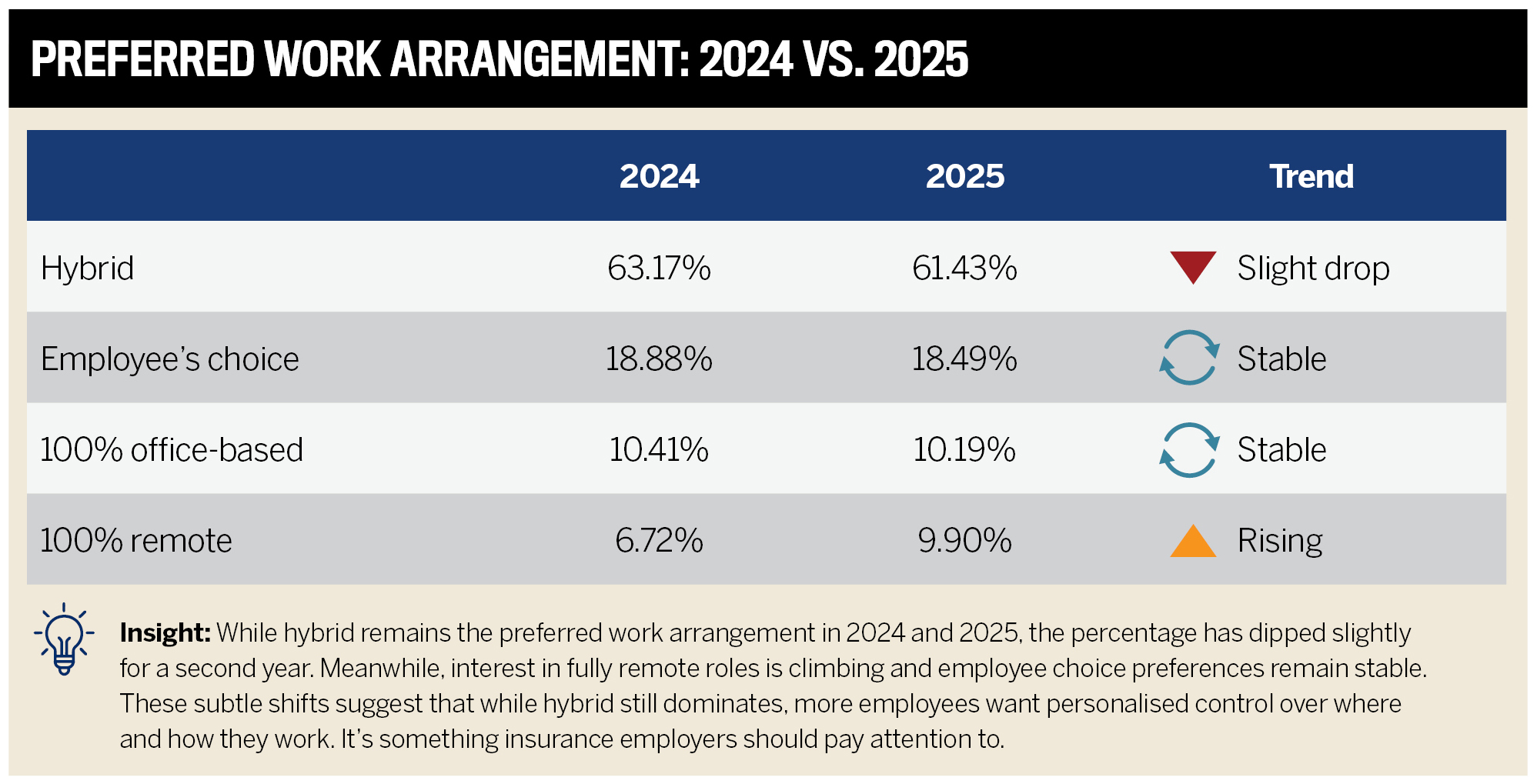
Hybrid holds, but autonomy gains ground
The data confirms that hybrid has moved from perk to baseline. However, employees’ enthusiasm for it may be starting to taper. A modest rise in fully remote preferences suggests that some are rethinking whether the office needs to be part of their work life at all.
Employers should note that what employees want is more control. Letting people decide where they work could be the difference between keeping and losing great staff.
Employee voice strengthens, but gaps remain
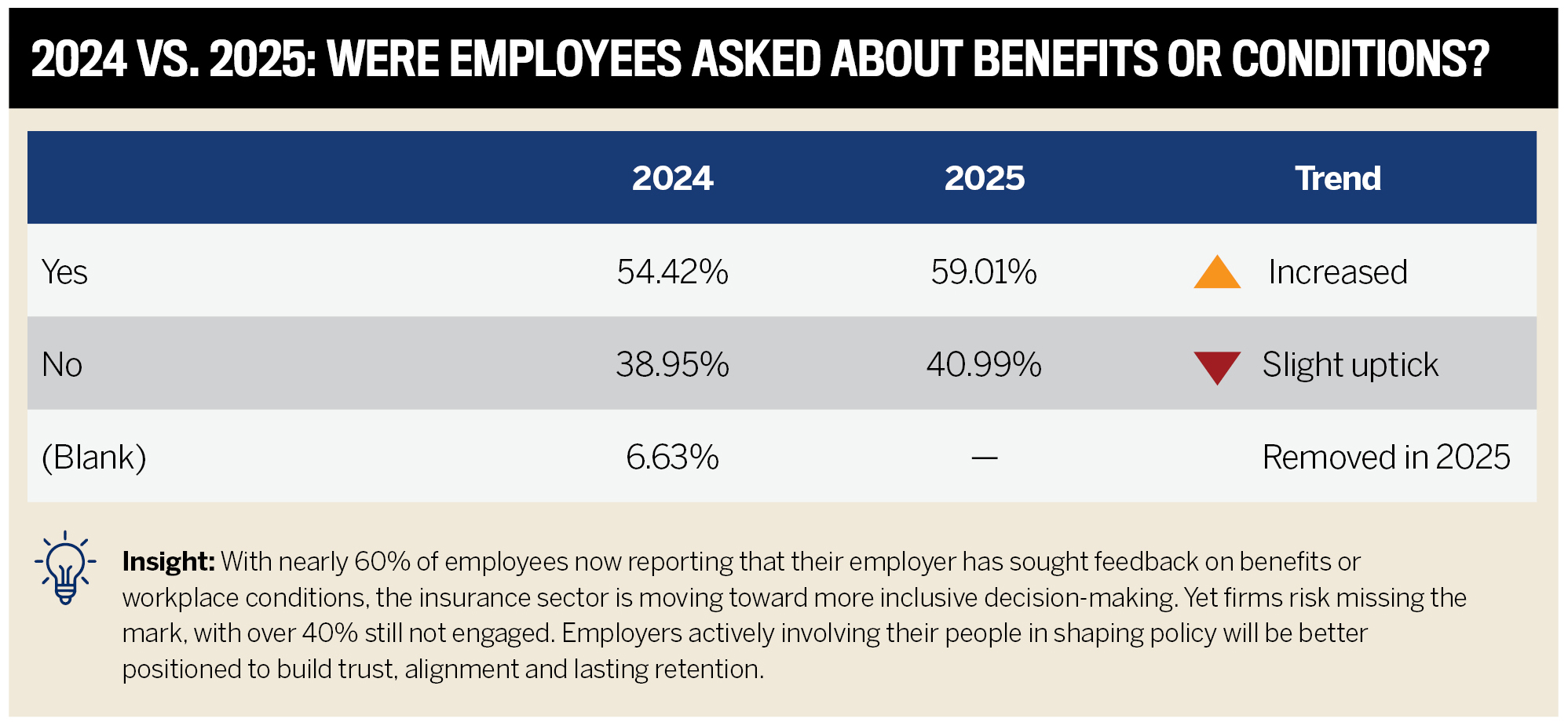
More insurance employers are seeking employee input on benefits and workplace conditions. Participation increased by nearly 5 percentage points from 54% to 59% in just one year. The proportion of employees who said they weren’t consulted also rose slightly, highlighting that while progress is being made, it’s uneven.
The shift signals growing attention to two-way communication and shared decision-making around benefits.
Fewer are looking for a new job, but don’t mistake it for complacency
In 2024 and 2025, fewer than 7% of employees said they were actively looking for a new role. The number moved by just 0.1 points. On the face of it, it suggests a steady workforce – but there’s more to it than that.
This isn’t about lowered ambition or people settling; it’s about alignment. When insurance employers get the basics right around flexibility, purpose and wellbeing, people aren’t staying by default. They’re staying by choice.
Inside the cultures employees don’t want to leave
Trust, flexibility and care are part of the daily routine at two of the best insurance companies to work for. These employers back up their culture with consistent action, earning loyalty no policy could buy.

For the third year running, New Zealand’s largest independent insurance broker network has been named one of the country’s Top Insurance Employers. The recognition speaks to its consistency and a culture of transparency, flexibility and connection.
“We operate with an open-door policy,” says chief operating officer Danielle Brookbanks. “We’re committed to open and transparent communication and encourage our team to bring their whole selves to work. That creates a sense of inclusion and psychological safety, where people feel comfortable sharing ideas or raising concerns.”
Employees work from home twice weekly, supported with the right tools and trust, but Brookbanks says flexibility is just the start. A shared sense of purpose and an active feedback loop help keep the culture grounded and leaders responsive.
“We recognise that employees have responsibilities outside of work, such as kids, hobbies, community commitments, and we try to take that whole-person approach to employment,” she says. “You don’t want to be the ambulance at the bottom of the hill. We use fortnightly pulse surveys and open-door policies to respond early and keep people happy.”
Recruitment is values-based, emphasising empathy, collaboration and diversity. Small rituals, such as birthday morning teas or team meeting shout-outs, reinforce a low-ego, high-recognition environment.


Danielle BrookbanksNZBrokers
Brookbanks also points to a shift post-COVID, where people want more balance, meaning and support.
“It’s not just about physical health anymore, it’s about mental health and community connection, too,” she adds.
NZBrokers offers flexibility and support across multiple dimensions:
-
Work-life balance: Flexible hours and paid volunteering days with a registered charity of the employee’s choice
-
Wellbeing: Health insurance and a whole-person approach to support
-
Growth and development: Cross-skilling, a company-wide skills matrix and training, even when not required for the role
Many employees, for instance, are completing Level 5 insurance qualifications to understand their broker members better, perform in their current roles and prepare for future opportunities.
What employees say:
-
“They are diverse, open, have a flat hierarchy and care about the employees personally. The culture is fantastic, and that is driven top-down. It is the best place I’ve ever worked”
-
“Great culture, great recruitment of the right people. Inclusivity”
-
“A calm and friendly office environment with no infighting or arguments, no toxicity in sight”
Keystone Underwriting Australia | Employee satisfaction rating: 96%
The underwriting agency has earned its first Top Insurance Employers recognition. Since its inception seven years ago, it has built a workplace grounded in trust, consistency and genuine care.
“We’re still a relatively young business,” says director Jon Willmott. “But we felt we’d reached the point where we should start putting ourselves forward for this kind of recognition. We believed we were ready, and it’s great to see that belief validated.”
Willmott attributes Keystone Underwriting’s high employee satisfaction to a few principles, including transparency, inclusiveness and follow-through.
The firm stands out with a commitment to the following:
-
Time and trust: Employees are trusted to manage their schedules despite an office-centric culture
-
Wellbeing perks: On-site Pilates, gym subsidies, health insurance, birthday leave, and personal wellness contributions from management
-
Location advantage: A suburban office location supports better work-life balance than a central business district (CBD) commute
We’re transparent, we act on feedback, and we make sure our people feel supported, not just as employees but as individuals,” he says. “We lead with inclusion and collaboration. There’s no gatekeeping here, just a culture of helping each other out.”
The office setup is deliberately flat. Everyone, from executives to junior staff, shares the same space, reinforcing a sense of openness. The team also eat lunch together daily, provided by the company. Remote workers are deliberately included, with extra effort made to ensure they never feel like an afterthought.

Jon WillmottKeystone Underwriting Australia
At Keystone, flexible work arrangements top the list of valued benefits. Leadership sees them as essential for employees who want to be trusted and work independently.
“Interestingly, about 90% of our team works in-office five days a week, not because they have to, but because they want to,” Willmott explains. “There’s a strong sense of ‘fear of missing out’ in the office these days, which is great. Half of our team had never worked in insurance before, so they value learning face-to-face from others.”
Keystone invests early and across all experience levels on development, from structured onboarding and mentorship to funded travel experiences that help accelerate confidence and build capability.
“We make sure everyone, not just top performers, gets exposure,” Willmott says. “This year, all junior staff went on business trips with a mentor. They see what the client-facing side of our industry looks like, and they gain confidence in their roles.”
What employees say:
-
“Keystone fosters a positive and inclusive work environment where everyone feels valued and heard. It’s truly a place where people look forward to coming to the office, thanks to the supportive and collaborative atmosphere”
-
“The level of teamwork and culture is nothing I have ever seen. No one is ever left behind”
-
“Keystone is a family. I feel part of the family even though I work remotely 90% of the time. The care that management has for their staff is something that should be admired”
Why alignment, not perks, drives retention in 2025
Culture has become a core business issue for insurance firms, and the most competitive employers are paying attention early, well before warning signs show up in exit interviews or falling engagement scores.
In 2025, the best insurance companies to work for are listening and responding.
-
Turnover is low because more people are finding what they need where they are.
-
Top employers are winning with intent. They embed care, flexibility and autonomy into the everyday.
-
A stable workforce creates space for employees to grow, be recognised and feel part of something that matters.
-
Leadership visibility, trust and values-based hiring now carry as much weight as compensation.
Best Insurance Companies to Work for in Australia and New Zealand | Top Insurance Employers


Less than 100 employees
- 1Cover Travel Insurance
- Agile Underwriting
- Arch Insurance Australia
- Clear Insurance
- Community Broker Network
- DUAL New Zealand
- Elliott Insurance The Green Broker
- Frank Risk Management
- FreightInsure
- Initio Insurance
- Interlink Insurance Brokers
- Keystone Underwriting
- Shielded Insurance
- Simplex Insurance Solutions
- Tapanda
100–499 employees
- Ansvar Insurance
- Australian Restoration and Construction
- DUAL Australia
- Helia
- McLardy McShane
- Sedgwick New Zealand
500–999 employees
- Crawford and Company Australia
- Tower Insurance
Insights
-
 Madeleine Martin
National Manager, Insurance and Wealth Management
Fuse Recruitment
Methodology
To find and recognise the best employers in the industry, Insurance Business invited organisations across Australia and New Zealand to participate by filling out an employer form outlining their various offerings and practices.
Next, employees from nominated companies were asked to complete an anonymous form evaluating their workplace on a scale from 1 (poor) to 5 (excellent) on various metrics, including benefits, compensation, culture, employee development and commitment to diversity and inclusion.
To be considered for the final list, each organisation had to reach a minimum number of employee responses based on overall size. Organisations that achieved a 75% or greater average satisfaction rating from employees were named Top Insurance Employers of 2025.
Keep up with the latest news and events
Join our mailing list, it’s free!