
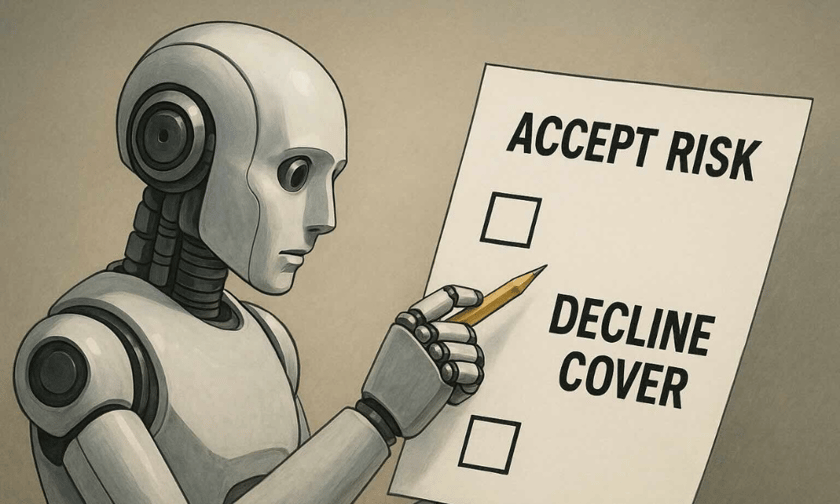
From the back offices of global reinsurers to the cloud-native platforms of startup underwriters, artificial intelligence is no longer knocking at the door of the insurance industry - it’s pulling up a chair, rewriting the rulebook, and asking uncomfortable questions.
A convergence of generative AI (GenAI), agentic systems, and cloud computing is reshaping everything from how insurers assess risk to how they recruit and train their people. And if industry leaders are right, it’s not just processes that are being retooled - it’s the very architecture of insurance itself.
“We’re not talking about replacing underwriters,” said Athula Alwis, CEO of AllDigital Specialty Insurance. “We’re talking about enhancing selection, scaling decision-making, and bringing speed to something that used to take days.”
The shift is both technical and philosophical. Gone are the days when underwriting was an exercise in risk containment after the fact. As Mohammad Khan, PwC UK’s general insurance leader, noted during a recent industry panel, AI is moving the sector from “reactive processing to continuous risk and claims management.”
Agentic AI, which enables systems to pursue goals and interact with the environment autonomously, is being positioned as the next frontier — one that could allow insurers to not only understand existing risk, but to anticipate future threats in real time.
Swiss Re’s global head of data and AI governance, Michael Föhner, calls it “a cultural shift,” likening the leap to learning how to drive a very fast car. “You have to be upskilled to manage this machine,” he said. He also described GenAI as a “magic tool” for handling unstructured data, which comprises roughly 80 per cent of the firm’s data universe.
“Instead of taking 30 minutes to review a reinsurance contract, we can now get answers in seconds,” said Föhner.
For newer players like AllDigital, AI is not a retrofit - it’s foundational. Since launching in 2021, the firm has written over $100 million in premium, powered by cloud-based systems and two proprietary AI engines. Its underwriting models rely on machine learning trained by seasoned underwriters and refined through a human-in-the-loop process.
Turnaround times that once spanned days now take mere minutes.
“Without cloud architecture, we wouldn’t exist,” Alwis said.
The efficiencies go beyond speed. Brokers, carriers, and administrators now operate on a shared digital platform, eliminating version-control disputes and enabling real-time collaboration. This connectivity has also allowed the firm to sidestep volatile segments - like employment practices liability in 2022 - where data confidence was low.
Yet for all the tech-driven promise, leaders caution that transformation cannot occur without people. Troy Dehmann, COO of global specialty insurer Beazley, says the biggest AI shift isn’t automation it’s skills.
“Every role in insurance will be affected,” Dehmann said. “The real transformation is around how we think about skills in the industry.”
Both Dehmann and Föhner expect a substantial overhaul of education and training programs - not just to enable faster adoption, but to ensure AI remains a sparring partner, not a substitute. “It’s still the underwriter making the decision,” Föhner said, “but it’s a very powerful assistant.”
The academic sector is now being enlisted to help accelerate that change, with calls for greater collaboration between universities and the financial services sector.
The appeal is undeniable. A recent McKinsey report suggests generative AI could add between $2.6 trillion and $4.4 trillion to global GDP annually - roughly equivalent to the UK’s entire economy. Insurance, with its mountains of unstructured documents and manual-heavy workflows, stands to gain significantly.
According to Deloitte’s Emerging Trends in Technology report, released during its annual Insurance Week, more than 90% of surveyed institutions have already increased their investment in GenAI, data infrastructure, and compliance automation.
Across the board, productivity gains are the low-hanging fruit. McKinsey’s survey of Europe’s largest insurers estimates that GenAI could lift productivity by 10 to 20% and technical results by up to three percentage points. Meanwhile, mentions of AI in annual reports by top insurers have more than doubled year-on-year.
But the tech gold rush comes with governance concerns. In sectors as heavily regulated as insurance, deploying GenAI without safeguards isn’t just risky - it’s reckless.
Deloitte’s “Trustworthy AI” framework outlines principles to ensure AI systems are robust, transparent, ethical, and secure. Swiss Re, for instance, has rolled out Life Guide Scout, an AI-powered assistant that helps underwriters navigate complex cases - but it operates under strict human oversight.
Alwis echoes the need for discipline. “We avoided embedded insurance,” he said. “The economics didn’t work. The integration costs were too high relative to the premium volume.”
AllDigital has instead focused on high-margin, data-rich opportunities and limited its partner count to under 20 firms. “We’re scaling by deepening relationships, not just expanding headcount,” Alwis said.
For now, the challenge is less about experimenting with GenAI and more about scaling it responsibly. McKinsey argues the most successful firms are those pursuing full end-to-end transformations rather than piecemeal deployments - linking underwriting, claims, fraud detection, and customer experience into a single intelligent system.
Some of the world’s largest insurers - Liberty Mutual, Intact Financial, Allstate, and Manulife among them - are already on that path, using AI to enhance everything from image analysis and call transcripts to premium segmentation and automated claims triage.
This isn’t just about faster quotes, says the industry. It’s about reengineering the business of insurance.
If they’re right, AI won’t just power the next wave of insurance innovation. It will define who survives it.



